
In most cases, no. New Hampshire’s RSA 159:3 makes it a class B felony for a person with certain felony convictions to own, possess or control a firearm. Federal law is broader still, and it applies even when the state statute does not. If you have a felony record and a gun is in your home, car or name, you should treat it as a live legal problem and get advice before you do anything else.
This guide covers who RSA 159:3 reaches, where federal law takes over, what “possession” means in practice, and the narrow routes people explore afterward.
TL;DR
- RSA 159:3 bars anyone convicted of a felony against a person or property, or a felony drug offense, from owning, possessing or controlling a firearm or other listed weapon. Violating it is a class B felony.
- Federal law, 18 U.S.C. § 922(g)(1), covers any crime punishable by more than one year in prison, whatever the offense. The maximum penalty is 10 years and a $250,000 fine.
- “Possession” includes a gun kept by a relative in your home if you know about it and can reach it.
- Restored state rights do not automatically restore federal rights. Check both before touching a firearm.
- Charged, on supervision, or unsure whether your record triggers the ban? Talk to a criminal defense attorney first.
Table of Contents
- What RSA 159:3 actually says
- Which convictions trigger the state ban
- Why federal law is the bigger problem
- What counts as possession
- Background checks: you will not slip past them
- Getting your seized firearms back
- Can your rights ever be restored?
- Our perspective
- If you are charged or under investigation
- FAQ
- Sources
What RSA 159:3 actually says
The statute has two parts that matter. The first is the prohibited act: owning, having in your possession, or having under your control a pistol, revolver or other firearm. The list is wider than guns. It also names weapons such as slungshots, metallic knuckles and other items the statute lists, so a conviction under this law is not limited to handguns. You can read the full list in the text of RSA 159:3.
The second is the category of person. The statute applies to someone convicted, in a state or federal court anywhere in the U.S. or its territories, of:
- A felony against the person or property of another.
- A felony under RSA 318-B, New Hampshire’s controlled drug act.
- A felony violation of another jurisdiction’s drug laws.
So an out-of-state conviction counts. A felony in Massachusetts or a federal court can put you inside the New Hampshire statute the same day you move here.
The statute also makes it a class B felony to complete and sign an application to purchase a firearm when you are a convicted felon under this section. In other words, a false or hopeful answer on a purchase form is a separate crime, even if the sale never goes through.
For how felony classes translate into sentences, see our guide to New Hampshire felony classes and our breakdown of what felony defendants face under RSA 625:9.
Which convictions trigger the state ban
The words “against the person or property of another” do real work. They cover the obvious categories: assault, robbery, burglary, theft-type felonies, arson and similar offenses. A felony drug conviction triggers the ban separately, no matter who the victim was or whether there was one.
That leaves a gap. Some felonies, in theory, fall outside those categories, such as certain regulatory or financial offenses depending on how they are charged. We would not rely on that gap. Two reasons:
- Whether an offense is “against the person or property of another” can be argued either way, and a prosecutor will argue it the broad way.
- Federal law does not have the gap at all.
Three or more felonies: the armed career criminal statute
New Hampshire adds a second layer for repeat offenders. RSA 159:3-a covers a person convicted of any combination of three or more felonies in this or another state under listed categories, including homicide, assault, sexual assault, arson and burglary. If you have a record like that, the stakes of any firearm possession charge rise considerably. Anyone in that position should speak with a felony defense attorney before talking to police about a weapon.
Why federal law is the bigger problem
Many people stop reading after the state statute and conclude they are fine because their felony was, say, a non-violent offense that falls outside RSA 159:3. That is the most common and most dangerous mistake.
Federal law, 18 U.S.C. § 922(g)(1), bars anyone convicted of a crime punishable by imprisonment of more than one year from possessing firearms or ammunition. The U.S. District Court for the District of New Hampshire states that the penalty is up to ten years in prison and a $250,000 fine. Note the phrase “punishable by”: what counts is the maximum possible sentence, not the sentence you actually received. The ban also covers ammunition, which many people overlook.
The same federal provision lists other prohibited groups, including fugitives, unlawful users of controlled substances, people adjudicated as mentally defective, and people subject to certain domestic violence orders or convictions. If you are facing a protective order, read our 30-day playbook for defending a restraining order in New Hampshire, because the firearm consequences can arrive before the case is resolved.

The Department of Justice’s quick reference to federal firearms laws also notes that a person with three or more prior convictions for certain serious offenses can face a mandatory minimum of 15 years. That is a federal sentence enhancement, separate from anything under New Hampshire law.
The practical rule: the stricter law wins. The federal court’s own guidance says offenders who believe their rights are restored under state law are likely still prohibited federally.
What counts as possession
People are rarely charged because they were caught carrying a gun in public. More often it is a gun found during a probation visit, a traffic stop, a domestic call or a search for something else.
Possession has two forms:
- Actual possession: the gun is on you or in your hands.
- Constructive possession: the gun is somewhere you have access to and control over, and you know it is there.
Constructive possession is where most surprises happen. Consider a spouse who owns a hunting rifle and keeps it in an unlocked bedroom closet you share. You never touch it. If you know it is there and can get to it, prosecutors can still argue you possess it. The federal court’s guidance for people on supervision says firearms need to be removed from a home where a prohibited person lives.
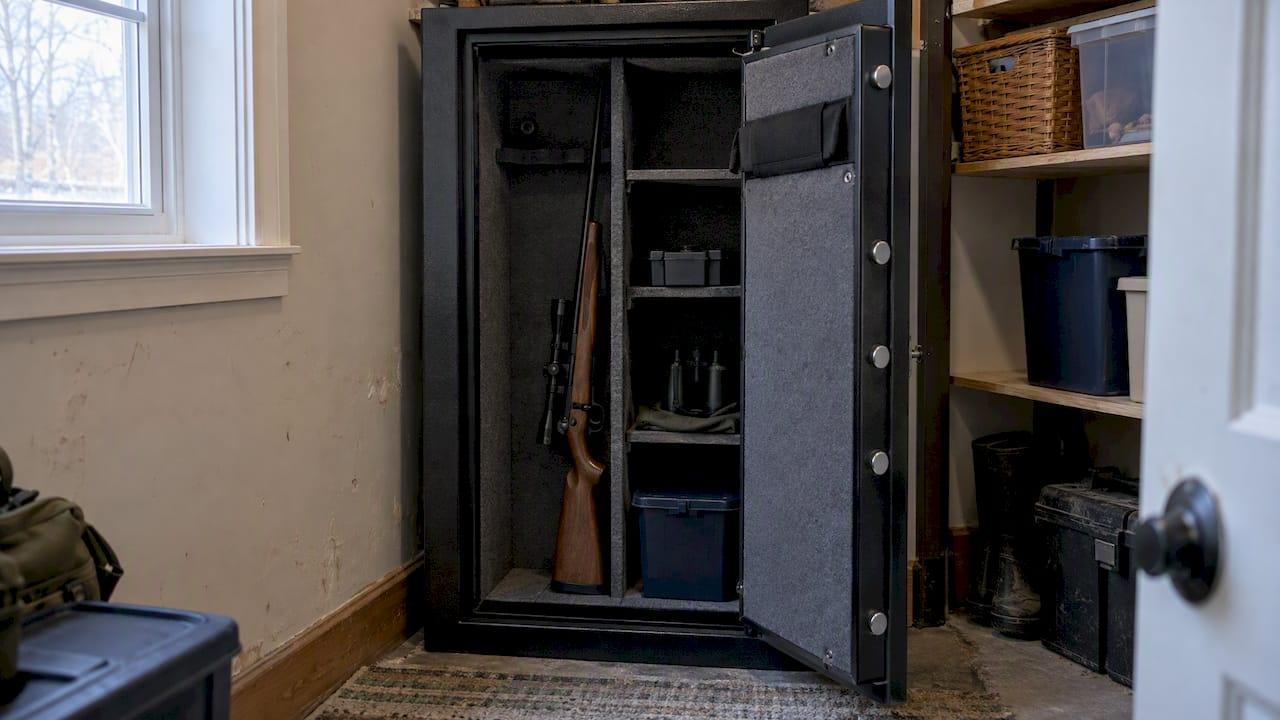
A gun safe can help only if the prohibited person has no key, code or other means of access, and even then the facts will be examined. A lawful owner who shares a home with a person with a felony record should talk to counsel before deciding how to store anything.
Supervision makes it worse
If you are on probation, parole or federal supervised release, a firearm discovery is treated as a serious violation. The federal court says that offenders convicted of a felony may not possess a firearm or ammunition during or after supervision. Officers who find a firearm must report it, and revocation proceedings often follow, whether or not you were “using” the weapon. You can lose your supervision status long before a new criminal case is decided.
Background checks: you will not slip past them
Some people assume that because New Hampshire does not require a license to buy a long gun, a felony will not surface. That assumption fails at the counter. According to the ATF’s Brady state listing, New Hampshire handgun checks run through the state Department of Safety, while long gun checks go through the FBI’s National Instant Criminal Background Check System. Licensed dealers run a NICS check before a transfer, and a state or federal felony record is exactly what it looks for.
Lying on the form is its own offense under RSA 159:3. A denial can also leave a paper trail that investigators notice. If you have been denied and believe the record is wrong, a lawyer can help you find out why.
Getting your seized firearms back
Sometimes the issue is not buying a gun but recovering one. Police may have seized firearms during an arrest, a protective order or an investigation, and the owner asks the court for their return.
New legislation addresses that process. According to the enacted bill text, RSA 159-D:4 sets a procedure for motions for return of firearms and ammunition, including a background check through the Department of Safety. Our reading of the text is that where a check comes back as a denial, the state must justify that denial at a hearing rather than simply refusing. If you need your property back, the motion should be prepared carefully, especially if there is any prior record. Do not assume that a dismissed charge ends the matter.
Can your rights ever be restored?
There are routes, but none is automatic and none should be assumed.
- Annulment of the conviction. New Hampshire allows annulment of eligible convictions after a waiting period, and it can change what your record shows. Eligibility is strict, and a single ineligible conviction can block the rest. See our annulment checklist under RSA 651:5 and our overview of annulment waiting periods.
- A pardon. A pardon is a separate and discretionary process through the executive branch.
- Federal relief. Federal rules are separate. Whether a state annulment or pardon removes the federal ban depends on the facts of your case and the law’s wording, which is why you need individual advice, not a general web answer.
Our advice: do not buy, borrow, hold or store a gun on the theory that an annulment should have fixed things. Wait for a lawyer’s written analysis of both the state and federal position. For the mechanics of a petition, see our page on criminal record annulment.
Our perspective
We see the same pattern again and again. A client with an old conviction, often years old, is charged with felon-in-possession after a gun is found in a house or vehicle. They did not think it counted, because the gun belonged to a spouse, because it was only a hunting rifle, or because the original sentence was light.

The prosecution’s case in these matters usually rests on three things: whether the prior conviction really qualifies, whether the client knew about the gun, and whether the client had control of it. Each is a place to test the State’s evidence. We read the conviction paperwork rather than the summary on a criminal history printout, look at how the search happened, and examine who else had access to the space. Our attorneys are former prosecutors, and we prepare every case as if it is going to trial, because that is what gives a client leverage.
The best outcome is often avoiding the charge. If you have a record and any firearm is near you, the time to call is before the knock at the door.
— Walter Ramos
If you are charged or under investigation
Firearm cases rarely arrive alone. They often travel with a drug charge, a domestic violence allegation or a probation violation. If that describes your situation, we handle the full range of criminal defense in New Hampshire, including gun and weapons charges, felonies and domestic violence, and you deal with an attorney directly from your first contact. We also offer Spanish-language representation. Our guides on concealed carry in New Hampshire and domestic violence versus assault cover related issues.
What to do right now:
- Do not discuss the gun with police, a probation officer or anyone else without counsel.
- Do not move the weapon yourself. Moving it can create new problems of possession.
- Write down who owns the firearm, where it was kept, and who had access to it.
- Collect your conviction paperwork, including the court, the statute and the date.
FAQ
Can a convicted felon own a gun in New Hampshire?
Generally no. RSA 159:3 prohibits it for people convicted of felonies against a person or property, and for felony drug offenses. Federal law bars nearly all felons regardless of the offense. Always check both before acting.
What disqualifies you from owning a gun in New Hampshire?
A qualifying felony is the main one, but federal law also lists fugitives, unlawful drug users, people adjudicated mentally defective, and people subject to certain domestic violence orders or convictions. Federal provisions apply to New Hampshire residents as well as to anyone else. A lawyer can tell you whether your particular record or order falls within them.
Does New Hampshire do background checks for guns?
Yes, in the sense that licensed dealers must run checks. Per the ATF, handgun checks run through the state Department of Safety and long gun checks go through the FBI’s NICS. A felony record will usually show up in either.
Can I keep a gun at home if my spouse owns it?
It is risky. If you know the gun is there and can get to it, a prosecutor may argue you possess it. Talk to a lawyer before deciding on storage arrangements.
Sources
- RSA 159:3, Convicted Felons (New Hampshire General Court)
- RSA 159:3-a, Armed Career Criminals (New Hampshire General Court)
- Firearm Possession Prohibition (U.S. District Court, District of New Hampshire)
- Overview Post-Conviction (U.S. District Court, District of New Hampshire)
- Quick Reference to Federal Firearms Laws (U.S. Department of Justice)
- Brady State Lists (ATF)
- Motions for the Return of Firearms and Ammunition, RSA 159-D:4 (New Hampshire General Court)
Recommended
- New Hampshire Felony Classes: Class A, Class B, and Beyond
- NH Felony Defense Attorney | Serious Charges
- New Hampshire Concealed Carry Laws: What You Need to Know
- NH Expungement: Annul Your Record in 1–10 Years (RSA 651:5)
This article is general information about New Hampshire criminal law, not legal advice, and does not create an attorney-client relationship with Granite Criminal Defense. Laws and court procedures change and every case is different. If you have been charged anywhere in Rockingham, Strafford, Hillsborough, Merrimack, Belknap or Carroll County, call us.
