

If your sentence is fully served and enough time has passed under RSA 651:5, you can likely get your record annulled. The next move is straightforward: file a Petition to Annul in the court that handled your case, or have an attorney review the file first if a prior conviction, an open probation term, or a barred offense makes eligibility unclear.
TL;DR:
- Annulment in NH treats convictions as if they never happened for most civil background checks, but law enforcement and federal agencies may still access the records.
- Waiting periods range from one to ten years after sentence completion, depending on the conviction type, with violent offenses and obstruction barred entirely from annulment.
- Filing requires separate petitions for each conviction, with necessary documents like judgment and proof of sentence completion, and delays often occur if the DOC questionnaire is not promptly returned.
- Legal assistance can improve success rates by ensuring correct procedural steps, evaluating eligibility, and organizing evidence to avoid three-year delays caused by common mistakes.
Table of Contents
- What Does Annulment Mean Under NH Expungement Law?
- How Long Do You Have to Wait to Annul a Record in NH?
- How Do You File a Petition to Annul in New Hampshire?
- How Much Does It Cost to Expunge a Record in NH?
- What Happens After the Court Rules on Your Petition?
- Practical Tips to Strengthen Your Petition and Avoid Delays
- When Legal Help Actually Moves the Needle
- Get Help Filing Your NH Annulment Petition
- Sources
- FAQ
What Does Annulment Mean Under NH Expungement Law?
New Hampshire doesn’t call it expungement. The statute uses “annulment,” and the distinction matters more than it sounds. Under RSA 651:5, an annulled conviction is treated, for most civil purposes, as if it never happened. Once a court grants it, the record disappears from the version employers, landlords, and licensing boards see when they run a standard background check.
That’s the practical upside, and it’s real. But annulment isn’t the same as physically shredding a file. Courts and law enforcement retain internal access for specific statutory purposes, and certain licensing boards can still see annulled records when a job involves vulnerable populations or firearms. Federal agencies are a separate problem entirely: the FBI and other federal bodies aren’t required to recognize a state annulment, so a federal background check can still surface a conviction New Hampshire has legally erased.
Compare that to how some other states handle “expungement,” which in a few jurisdictions means outright destruction of the file. New Hampshire’s model is closer to sealing with strong legal effect than to physical erasure. If you’re weighing whether annulment solves a housing or employment problem, that’s the framework to plan around, not the more absolute version of expungement you may have read about elsewhere. It also means an annulment can meaningfully change how a record affects your job prospects in New Hampshire without erasing every trace of the case from every database that might touch it.
How Long Do You Have to Wait to Annul a Record in NH?
Waiting periods run from the day you finish every part of your sentence, not from the date of conviction. That includes probation, fines, and restitution. Miss that detail and you’ll file too early, which is one of the most common reasons petitions get dismissed before a judge even considers the merits.
Under RSA 651:5, the standard waits are:
- Violation: 1 year after completing the sentence
- Class B misdemeanor: 2 years
- Class A misdemeanor: 3 years
- Class B felony: 5 years
- Class A felony, sexual assault, or misdemeanor domestic violence: 10 years
Controlled substance convictions under RSA 318-B and DUI offenses under RSA 265-A:21 carry their own carve-outs and can be affected by prior convictions on your record, which extends or complicates eligibility. Violent crimes and obstruction of justice offenses are barred from annulment altogether, regardless of how much time has passed.
How Do You File a Petition to Annul in New Hampshire?
The petition goes to the court that handled your original case, and if you have more than one conviction, you file a separate petition for each one. Combining charges into a single filing is a common mistake that slows everything down.
- Get your case documents together. You’ll need the judgment of conviction, proof the sentence was fully completed, and any relevant court dates.
- File the Petition to Annul using the form listed on the New Hampshire Judicial Branch’s annulment page, filed in the same court that sentenced you.
- Wait for DOC notification. The court clerk notifies the Department of Corrections, which opens an investigation and typically mails you a questionnaire.
- Return the DOC questionnaire immediately. Delays here are the single biggest bottleneck in the entire process.
- The prosecutor gets 20 days to object. If no one objects, the court can grant the petition without a hearing. If you want a hearing anyway, you can request one.
Bring more than the bare minimum. Discharge certificates, receipts showing restitution or fines were paid in full, and letters of support from employers or community members all strengthen the file the judge is reviewing.
Pro Tip: Keep copies of everything you submit to DOC and the court. If your questionnaire gets lost in the mail, having your own paper trail lets you resend instantly instead of restarting the clock.
How Much Does It Cost to Expunge a Record in NH?
Three separate fees apply, and they go to three different agencies, so budget for all of them before you file.
- Court filing fee: $125
- DOC investigation fee: $100
- NH State Police administrative fee: $100 per court of jurisdiction
If you filed in two different courts for two separate cases, expect to pay the NHSP fee twice. An indigency affidavit can waive the court’s $125 filing fee, but it typically does not waive the DOC or State Police fees, which are set by statute with narrow exceptions.
Timing varies by agency. The DOC investigation and court scheduling depend on caseload and can take weeks to months. Once the court approves the annulment and payment reaches NH State Police, the Criminal Records Unit typically clears the state-side record within 1 to 2 business days. FBI database updates lag behind that, often taking several weeks, which matters if you’re timing the annulment around a background check deadline.
What Happens After the Court Rules on Your Petition?
A grant sets off a specific chain of events. The court issues a certificate of annulment and notifies NH State Police and the relevant agencies that held the record. From that point, most employment, housing, and background checks in New Hampshire should come back clean.
“Should” is the operative word, because access doesn’t vanish for everyone. Law enforcement, certain courts, and a handful of statutory exceptions retain the ability to view annulled records. Federal agencies fall outside NH’s authority entirely; they can decline to recognize the annulment, which matters if you’re applying for a federal job, a security clearance, or certain federal licenses.

A denial isn’t the end of the road, but it does cost you time. Court rules require a three-year wait before you can re-petition on the same conviction. That’s a long window to sit on a denial you might have avoided with a stronger filing the first time. Use it to gather better evidence of rehabilitation, fix whatever procedural gap sank the first petition, or bring in an attorney before you try again.
Practical Tips to Strengthen Your Petition and Avoid Delays
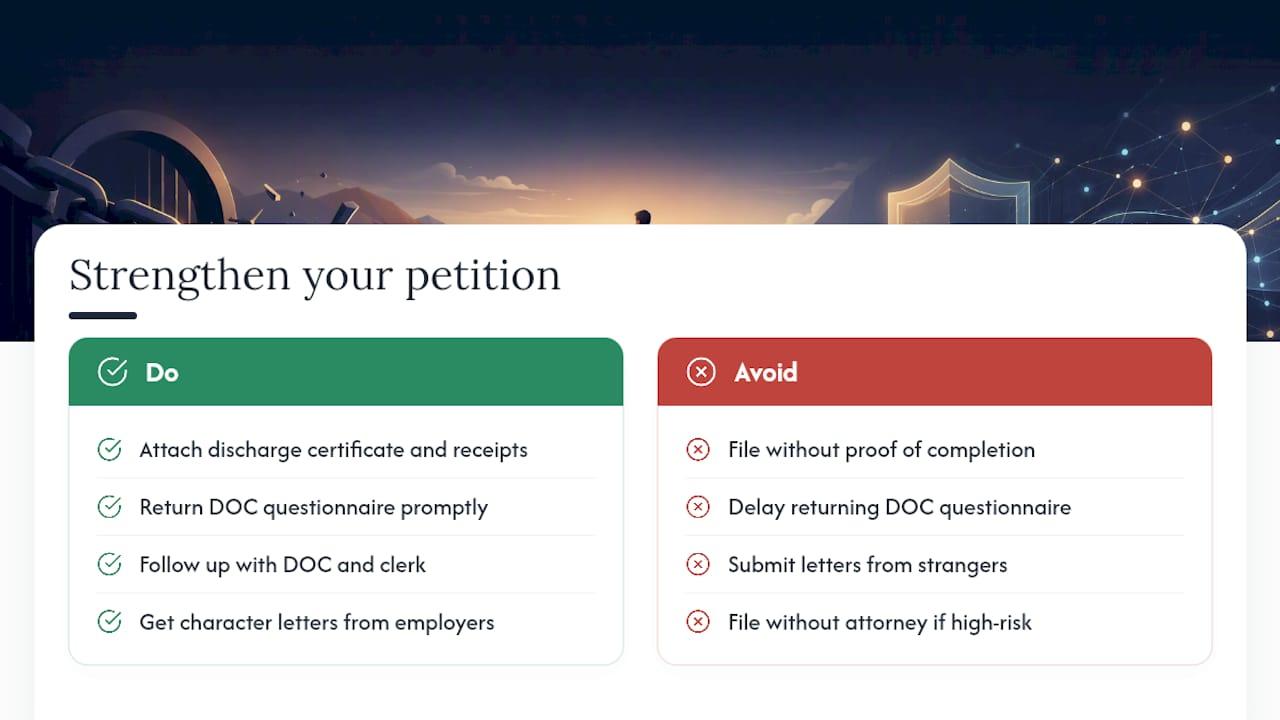
Documentation wins these cases more often than legal argument does. Pull your discharge certificate and payment receipts before you file, not after DOC asks for them. A petition missing proof of sentence completion gets dismissed on a technicality, and you’ll have wasted the filing fee.
Speed matters just as much as substance. Return the DOC questionnaire the day it arrives, then follow up with both DOC and the court clerk if you haven’t heard anything in a few weeks. Agencies are juggling hundreds of files at once, and a polite check-in can move yours back onto someone’s desk.
Character letters carry more weight when they come from people with standing: employers, supervisors, counselors, people the court has reason to trust. If your eligibility is borderline, if you’re carrying a felony conviction, or if a statutory bar might apply, get an attorney to evaluate the risk before filing. A denied petition locks you out for three years.
When Legal Help Actually Moves the Needle
Most people can file a straightforward, single-charge petition on their own once the waiting period has run. Where it gets complicated is multiple convictions, a felony record, or any ambiguity about whether a specific charge falls under a statutory bar. Getting that wrong doesn’t just cost you the filing fee. It costs three years.
Eligibility reviews, drafting paperwork, organizing rehabilitation evidence, and coordination with DOC and the court clerk can help prevent annulment petitions from stalling. That coordination is often the difference between a clean grant and months of back and forth over a missing form.
— Rich
Get Help Filing Your NH Annulment Petition
Experienced legal assistance can help catch procedural mistakes that lead to annulment petitions being dismissed before a judge reviews the merits. Filing too early, missing a DOC questionnaire deadline, or misjudging whether a prior conviction triggers a statutory bar are the kinds of errors that cost you a three-year wait, and they’re avoidable with the right review upfront.
Legal professionals can evaluate eligibility, draft petitions, organize rehabilitation evidence, and coordinate with DOC and NH State Police to help prevent delays in processing. If you’re ready to move forward, visit the criminal record annulment practice page to request a case review, or reach the firm directly through Granitecriminaldefense to schedule a consultation.
This article is general information, not a substitute for advice from a qualified lawyer. Consult a qualified legal professional about your own circumstances before acting on anything here.
Sources
- Criminal Record Annulments | NH State Police
- Annulment forms and guidance — New Hampshire Judicial Branch
FAQ
How much does it cost to expunge your record in NH?
Expect three fees: a $125 court filing fee, a $100 DOC investigation fee, and a $100 NH State Police administrative fee per court of jurisdiction. Indigency can waive the court fee, but usually not the other two.
How do you get your record expunged in NH?
File a Petition to Annul in the court that sentenced you, wait for the DOC investigation and prosecutor review period, and the court can grant it without a hearing if no one objects within 20 days.
Is annulment worth it?
For most people, yes, since it removes the conviction from the record most employers, landlords, and licensors see. It won’t clear federal databases or block every statutory exception, so weigh that against your specific situation, particularly if a misdemeanor versus felony distinction affects your waiting period.
How long does a misdemeanor stay on your record in NH?
A class B misdemeanor becomes eligible for annulment 2 years after the sentence is fully completed, while a class A misdemeanor requires a 3 year wait. Until you file and get a grant, the conviction stays visible on standard background checks.
