

If you have been charged with a crime in Manchester, your first court date is your arraignment, and it happens fast. It is a short hearing where the judge tells you the charges, addresses bail and takes your plea. It is not a trial, and what you say and do before and during it can shape the rest of your case. The best time to hire a Manchester criminal defense lawyer is before that date, not after it. Below we explain what the hearing is, what to bring, and how the main kinds of representation compare.
TL;DR
- Your first appearance is an arraignment: charges read, bail set, plea entered. No evidence is weighed.
- If you were not detained, the arraignment is generally set no earlier than 35 days after release. If you are held, it must come within 24 to 36 hours, excluding weekends and holidays.
- Bring your arrest or summons paperwork. Do not bring witnesses or evidence.
- For a class A misdemeanor or felony, only a lawyer can file a written waiver so you can skip the personal appearance.
- You have four realistic options: a court-appointed lawyer, a solo private lawyer, a general-practice firm, or a criminal-defense-only firm. The right one depends on the charge and the stakes.
Table of Contents
- What actually happens at a Manchester arraignment
- What to bring, and what to leave at home
- Can a lawyer appear for you?
- Clocks that start before your court date
- Your options for a Manchester defense lawyer
- Our perspective: what we tell people the week before court
- How we can help in Manchester
- FAQ
- Sources
What actually happens at a Manchester arraignment
Most Manchester misdemeanor and violation cases start in the 9th Circuit, District Division, Manchester, at 35 Amherst Street. The court lists weekday hours of 8:00 a.m. to 4:00 p.m. Felony cases begin in district court too, then move up to superior court. Our guide to the NH court system shows where each kind of case ends up.
At the arraignment, three things happen:
- The charges are read. You learn exactly what the State alleges and which offense class it falls in.
- Bail is addressed. The judge decides whether you are released and on what conditions, such as no contact with an alleged victim, no alcohol or travel limits.
- You enter a plea. Usually that is not guilty, which preserves every defense.
The court does not evaluate your evidence at this stage. According to the state’s arraignment rule, the real work of examining evidence and building a defense happens between the arraignment and trial. That is why the days before it matter: a lawyer who has the police report and your facts in hand can often shape bail arguments and avoid early mistakes. For more on timing and why the plea matters, see our article on arraignments in New Hampshire.
How soon is it?
It depends on whether you were held.
| Situation | When the arraignment happens |
|---|---|
| Released on a summons or by a bail commissioner | Generally no earlier than 35 days after release |
| Detained | Within 24 to 36 hours, excluding weekends and holidays |
Both timelines come from Rule 4 of the NH criminal procedure rules. If you were released with a date weeks away, do not treat that gap as spare time. Some deadlines run on their own clocks, as we explain below.
What to bring, and what to leave at home
The court’s own What to Bring page says to bring any paperwork from your arrest or summons, and not to bring witnesses or evidence to the first appearance. People often think they should show up with texts, photos or a friend who saw everything. That material belongs to the trial phase, and handing it over early can hurt you. The district division criminal page makes the same point.
A practical checklist:
- Your summons, bail paperwork or release conditions
- Photo ID
- Your lawyer’s contact information
- A list of your own questions about conditions of release (work, travel, firearms, contact with a named person)
- Something to say to your employer, in case you miss work
Do not discuss the facts with the prosecutor, a police officer or other people in the hallway. Court staff can explain procedure, but they cannot give legal advice. If you do not qualify for court-appointed counsel, you need your own attorney.
Can a lawyer appear for you?
Sometimes. A defendant charged with a class A misdemeanor or felony can waive arraignment only through a lawyer who files a written waiver, under the same Rule 4. Class B misdemeanors and violations usually have simpler waiver paths. This matters if you work shifts, live out of state, or are a student heading back to campus. It also explains why many people hire counsel early: the first date may not require you to stand in the courtroom at all.
The class of the charge also drives the stakes. The judicial branch’s definitions page explains the difference between class A and B misdemeanors, and our pieces on misdemeanor vs. felony and felony classes and prison terms go further.

Clocks that start before your court date
Some consequences do not wait for the arraignment.
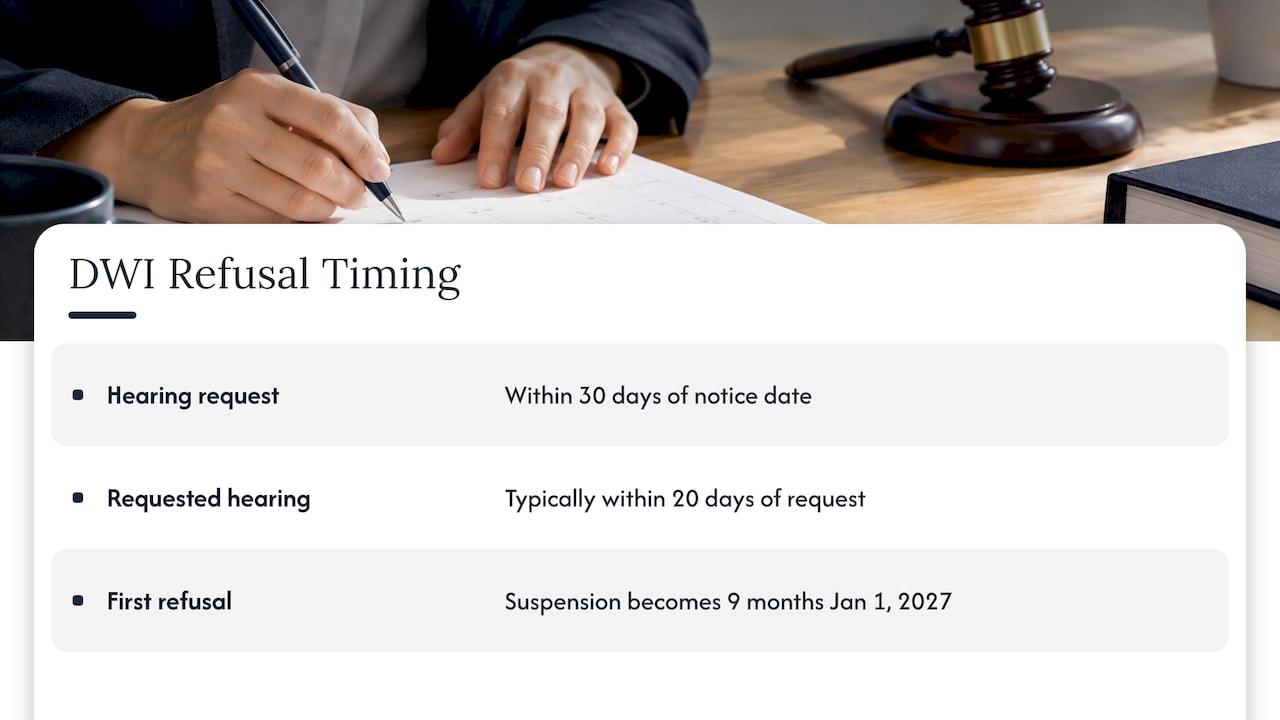
DUI and chemical test refusal. If you refused a breath or blood test, you must request an administrative hearing about your license suspension in writing within 30 days of the notice date. If you request it, the hearing is typically held within 20 days. These rules sit in RSA 265-A:14. The same statute says that, as of January 1, 2027, the suspension for a first refusal increases to 9 months. Missing the 30-day window can cost you the chance to contest the suspension, even if your criminal case is weeks from being heard. We walk through it in our 30-day DUI license checklist, and cover blood test refusals and out-of-state drivers separately. Note that NH calls the offense DWI, and many people still say DUI; we explain the terms in DUI vs. DWI.
Protective orders. If you have been served with a domestic violence restraining order, the rules are strict. Even if the plaintiff invites contact, you remain prohibited from it unless the court modifies the order, and officers must enforce it as written. A text that seems friendly can become a new criminal charge. See our six steps after a restraining order and the 30-day playbook.
Simple assault. Under RSA 631:2-a, simple assault covers purposely, knowingly or recklessly causing bodily injury, and negligently causing injury with a deadly weapon. It is a misdemeanor, but it becomes a violation if it happened in a fight entered into by mutual consent. That distinction can change what you face, which is why the facts of the incident matter before any plea. Our assault penalties guide maps outcomes to facts.
University discipline. If you are a student, a criminal charge can run alongside a campus case. UNH’s sexual misconduct policy says the university may temporarily delay its process at the request of law enforcement. In those hearings, your advisor is the only person allowed to conduct real-time cross-examination, and you cannot do it yourself. Choosing an advisor with courtroom experience is therefore a real decision.
Your options for a Manchester defense lawyer
No single kind of lawyer fits every case. Here is an honest comparison by type.
| Court-appointed counsel | Solo private lawyer | General-practice firm | Criminal-defense-only firm | |
|---|---|---|---|---|
| Cost | Free or reduced if you qualify | Retainer or hourly | Retainer or hourly | Retainer or hourly |
| Focus | Criminal, high caseload | Varies, often several areas | Criminal is one of many areas | Criminal only |
| Who you reach | Assigned attorney | The lawyer | Sometimes staff first | Depends on the firm |
| Best for | People who cannot afford counsel | Straightforward, lower-stakes cases | Cases overlapping with family or injury law | Contested, high-stakes or complex cases |
Court-appointed counsel
New Hampshire provides appointed lawyers to defendants who cannot afford one. One overview of the state’s indigent defense system notes that this stems from the constitutional right to counsel recognized in Gideon v. Wainwright. If you qualify, use it. Appointed lawyers are often skilled trial attorneys. The tradeoff is usually caseload, which can limit how much time a lawyer can spend on independent investigation. The court will ask about your finances at or before the first date, so be ready to answer.
A solo private lawyer
A solo practitioner can give you personal attention and often lower overhead. Ask how many trials they have actually tried recently and whether they handle your type of charge regularly. A lawyer who mostly does real estate and takes the occasional OUI may not know the local prosecutors’ habits.
A general-practice firm
These firms suit people whose problem spans areas, such as a criminal charge with a divorce in the background. The questions to ask are who will actually appear in court for you and how much of the firm’s work is criminal.
A criminal-defense-only firm
This is where we sit. Granite Criminal Defense handles criminal defense only, with no other practice areas. Our attorneys are former prosecutors with decades of insight into how the State builds cases. You have direct access to your attorney from first contact, and we have a bilingual English/Spanish attorney. We prepare every case as if it is going to trial, because that preparation is what gives you leverage in negotiations. Our work covers DUI/DWI, misdemeanors, felonies, domestic violence, drug crimes, assault, gun charges, protective orders, Title IX defense and record annulments.
Questions to ask any lawyer before you hire
- Will you appear at my arraignment, or can you waive it for me?
- Who will handle my case day to day, and can I reach that person directly?
- What will you do to investigate before the first hearing?
- How is the fee structured, and what does it cover?
- What happens to my license, job, immigration status or school standing?
If an answer is vague, keep looking. A fee estimate should be specific to your charge. We do not publish flat prices because cases differ widely, so we quote after reviewing your facts.
Our perspective: what we tell people the week before court
People arrive scared and a little embarrassed. The first thing we tell them is that the arraignment is the least important hearing in the case, and the most commonly mishandled. The charge is read, the plea is entered, and the real fight begins afterward. What hurts people is what happens around the hearing: talking to an officer, answering the other party’s messages, posting online, or missing a deadline on a license hearing that nobody told them about.
Because we are former prosecutors, we know what the State looks for when it reviews a file. We know which gaps in a police report matter and which do not. We use that to examine the evidence closely, run our own investigation and prepare the case as if it will be tried. Many cases do resolve without trial, but the ones that resolve well are usually the ones where the State knew the defense was ready.
If you take one thing from this page, make it this: call a lawyer as soon as you have a charge or a summons, not the day before court. The earlier we start, the more options you keep.
— Walter Ramos
How we can help in Manchester
If you are facing a charge in Manchester, we can review your paperwork, explain your first court date and tell you which deadlines are running. You can see the full list of what we handle on our practice areas page, or start from specific pages for DUI defense, misdemeanor defense and felony defense. Contact us through Granite Criminal Defense and speak with an attorney directly.
FAQ
Do I need a lawyer for my first court date?
You are not required to have one for a misdemeanor or violation arraignment, but it is wise. For a class A misdemeanor or felony, only counsel can file a written waiver so you do not appear in person. A lawyer can also advise on bail conditions and your plea before you stand in front of the judge.
What plea should I enter at arraignment?
Most defendants plead not guilty at this stage, which keeps all defenses open and gives your lawyer time to review the evidence. A guilty plea may be hard to undo and can carry consequences for your job, license or immigration status. Talk to a lawyer before you decide.
Should I bring evidence or witnesses?
No. The court says to bring your arrest or summons paperwork only, and not to bring witnesses or evidence to the first appearance. Those are for a later trial.
What if I cannot afford a lawyer?
Tell the court you want to apply for appointed counsel. If you qualify, a lawyer is assigned. If you do not qualify, court staff cannot advise you, so you will need to hire your own attorney.
Does the court date stop the license suspension clock after a refusal?
No. The administrative hearing request has its own deadline: 30 days from the notice date in writing, under RSA 265-A:14. Your criminal arraignment may fall after that window, so act on the license issue right away.
Sources
- Rule 4, Initial Proceedings in Circuit Court, District Division (NH Judicial Branch)
- Criminal, District Division (NH Judicial Branch)
- What to Bring (NH Judicial Branch)
- Hillsborough County District Divisions (NH Judicial Branch)
- Definitions, Criminal (NH Judicial Branch)
- RSA 265-A:14, Refusal of Consent
- RSA 173-B:5, Relief
- RSA 631:2-a, Simple Assault
- UNH Policy Prohibiting Sexual Misconduct
- New Hampshire Public Defender System and Indigent Defense
Recommended
- The NH Court System Explained: Where Your Case Actually Goes
- 48 Hour Rule in New Hampshire Arraignments and Why Your Plea Matters
- First 48 Hours: Fight Sexual Assault Charges in New Hampshire
- NH Felony Defense Attorney | Serious Charges
This article is general information about New Hampshire criminal law, not legal advice, and does not create an attorney-client relationship with Granite Criminal Defense. Laws and court procedures change and every case is different. If you have been charged anywhere in Rockingham, Strafford, Hillsborough, Merrimack, Belknap or Carroll County, call us.
