
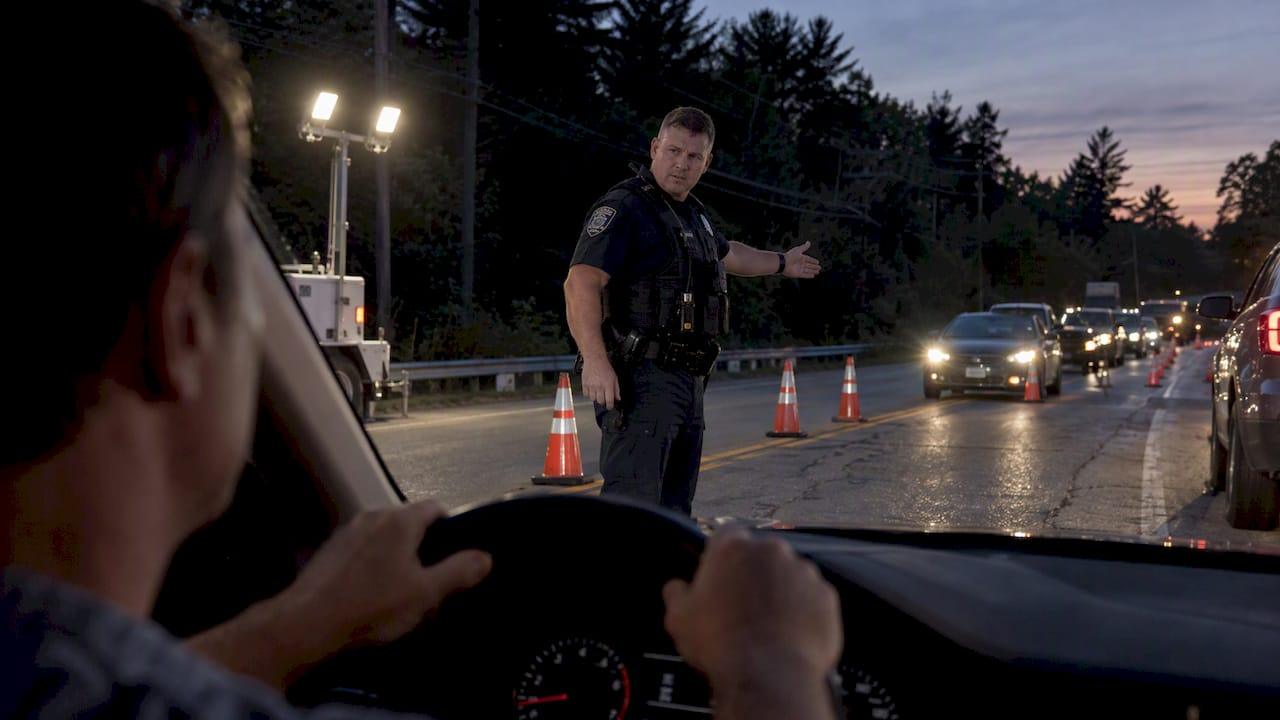
Yes, you must comply when an officer signals you to stop. New Hampshire permits sobriety checkpoints only after a Superior Court order under RSA 265:1-a, and refusing a lawful signal to stop can trigger separate penalties. If you believe a checkpoint lacked that authorization, document everything you can and talk to a lawyer before saying more than you have to.
TL;DR:
- A checkpoint plan must receive Superior Court approval, use a consistent vehicle selection method, and provide brief stops, clear signage, and lighting.
- Refusing a lawful officer signal can bring a $100 fine; purposely failing to stop for a uniformed officer is a misdemeanor carrying at least $500.
- A legal turn before reaching a checkpoint is generally allowed, but exposure begins when you ignore an officer’s signal or commit a separate traffic violation.
- A defense review compares the actual stop with the plan approved by the court and examines detention length, particularly before officers develop independent suspicion.
- Obtain and preserve the date, time, exact location, officer details, witness contacts, and any citation; safely recorded video may help before footage is overwritten.
Table of Contents
- What RSA 265:1-a says about sobriety checkpoints
- Do you have to stop? Driver duties under RSA 265:3 and RSA 265:4
- How checkpoints get authorized and what they look like in practice
- If you think a checkpoint stop was unlawful: what to do next
- How we review checkpoint stops at Granite Criminal Defense
- If you were stopped, cited, or arrested at a checkpoint
- FAQ
- Sources
What RSA 265:1-a says about sobriety checkpoints
New Hampshire lawmakers did not leave checkpoint authority to individual police departments. RSA 265:1-a requires law enforcement to petition the Superior Court before setting up a sobriety checkpoint meant to enforce criminal traffic laws. The statute took effect on January 1, 1997, and it has governed checkpoint authorization in the state ever since.
In plain English, the law asks a judge to answer two questions before any checkpoint goes up:
- Is the checkpoint warranted, meaning is there a legitimate public safety reason to use this enforcement method at this time and place?
- Does the proposed stopping method satisfy constitutional guarantees against unreasonable searches and seizures?
A Superior Court order is not a formality. It is the legal event that converts a roadside stop of every passing vehicle, something that would otherwise be an unreasonable seizure, into a lawful enforcement tool. Without that order, officers have no statutory basis under RSA 265:1-a to run a sobriety checkpoint for criminal enforcement purposes. That single requirement shapes almost everything else in this area of New Hampshire law, including what a defense attorney looks for first when a checkpoint case lands on their desk.
Do you have to stop? Driver duties under RSA 265:3 and RSA 265:4
Once an officer signals you to stop, whether at a checkpoint or on an open road, New Hampshire law expects you to comply. RSA 265:3 makes willful refusal to obey a lawful traffic-control order from a police officer an offense carrying a $100 fine. RSA 265:4 goes further: purposely failing to stop when signaled by a uniformed officer is a class A misdemeanor, with a fine of at least $500, and the penalties escalate sharply if an attempt to flee causes serious injury or death.
Here is what that looks like in practice:
- Slow down and stop where directed, even if you think the checkpoint seems unusual or poorly marked.
- Keep your hands visible and stay in your vehicle unless an officer asks you to step out.
- Have your license, registration, and proof of insurance ready to hand over when asked.
- Answer identifying questions calmly, but you do not need to volunteer more than the officer asks for.
- If you are detained or arrested, state clearly that you want to speak with an attorney before answering further questions.
Driving around a checkpoint is not automatically illegal, since you are generally allowed to make a legal turn before reaching one. What creates exposure under RSA 265:4 is refusing to stop once an officer has already signaled you, or attempting to elude after that signal is given. Our field sobriety guide walks through what happens once you are stopped and asked to perform roadside tests.
Pro Tip: Stay cooperative with instructions like pulling over and producing documents, but keep verbal answers short. You can be polite and still decline to explain where you have been or how much you had to drink.
How checkpoints get authorized and what they look like in practice
Before a single car gets waved over, an agency has to go through a formal process. It petitions the Superior Court, lays out the public safety justification, and proposes a specific method for selecting which vehicles get stopped, such as every third car or every vehicle at set intervals. The court reviews that plan against both the statutory “warranted” standard and constitutional reasonableness, then issues an order if it approves.
Courts generally expect the operational plan to include features that limit intrusion on drivers who are not suspected of anything, such as brief detention times, a nondiscretionary vehicle-selection method, and visible signage and lighting for safety. No single checklist applies to every checkpoint, but these elements tend to recur in plans that survive scrutiny.
A real example: in September 2019, NH State Police publicly announced a sobriety checkpoint in Bedford, stating it was authorized by the Superior Court and involved multiple agencies working together on traffic safety enforcement. That kind of announcement is useful evidence that a checkpoint was publicized and planned, but it does not replace the actual court order. If a dispute arises later, the court record, not the press release, is what proves authorization.
At a checkpoint consistent with an authorized, safety-focused operation, you can generally expect:
- Clear signage, lighting, and uniformed officers directing traffic.
- A consistent pattern for which vehicles get pulled aside rather than officers picking cars at random.
- Brief initial contact focused on license, registration, and observation, not an extended roadside investigation unless something specific is observed.
If you think a checkpoint stop was unlawful: what to do next
If something about a checkpoint seems off, the details you capture in the moment matter later. Write down the date, time, and exact location as soon as you can. Note which agency or agencies were present, any vehicle or unit numbers you saw, and officer names or badge numbers if they were visible or printed on a citation.
A few other steps worth taking:
- Record video or audio on your phone if you can do so safely and without interfering with officers.
- Get the names and contact information of any passengers or bystanders who witnessed the stop.
- Keep any paperwork you were given, including citations, warnings, or printed checkpoint notices.
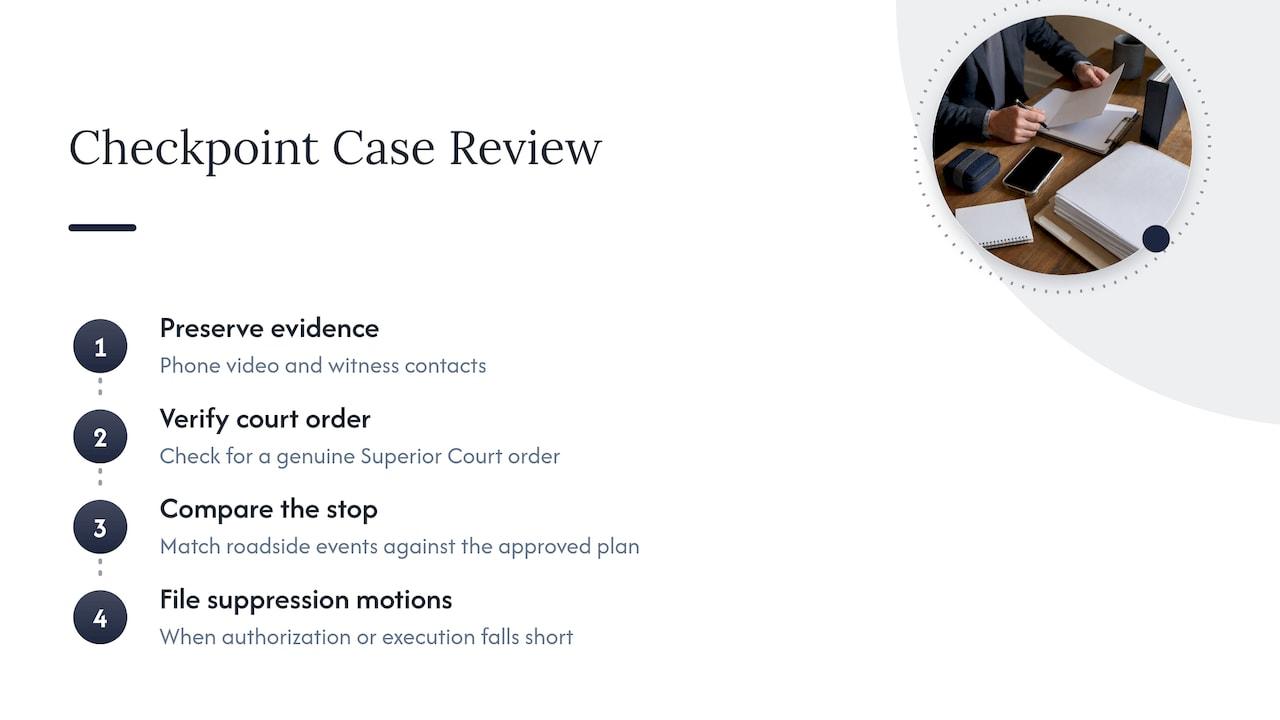
Defense counsel reviewing a checkpoint case will typically request the Superior Court petition and order, the department’s operational plan, and any available dash-cam or body-cam footage to see whether what happened on the road matched what the court actually approved. Early review matters because evidence can disappear, footage can be overwritten, and memories fade.
Pro Tip: Limit what you say at the scene beyond basic identifying information. Anything you volunteer about drinking, timing, or where you were coming from can become part of the record against you later.
How we review checkpoint stops at Granite Criminal Defense
Court authorization is the starting point in any checkpoint case, but it is rarely the end of the analysis. Courts weigh the totality of circumstances, which means execution matters just as much as paperwork. A checkpoint with a valid Superior Court order can still face a strong challenge if officers deviated from the approved stopping method, extended detentions well beyond a brief observational stop, or skipped the signage and safety measures the court relied on when it issued the order.
In our experience reviewing these cases, the fact pattern that most often determines whether evidence gets suppressed comes down to three things: whether a court order existed at all, whether the actual stop matched the approved plan, and how long the detention ran before officers developed independent suspicion. Reaching out early gives us time to request records before they are lost.
— Walter Ramos
If you were stopped, cited, or arrested at a checkpoint
If a checkpoint stop led to a citation or arrest, we provide DUI and DWI defense built around exactly this kind of procedural scrutiny. Our team has decades of combined courtroom experience, including former prosecutors who know how the state builds these cases from the inside, and every file is prepared as though it is heading to trial so we have full leverage at every stage.
We review whether the checkpoint had a genuine Superior Court order, compare what happened on the road against that approved plan, and file motions to suppress when the authorization or execution falls short. We also advise clients on preserving evidence, from phone video to witness contacts, before it disappears.
If you were stopped at a checkpoint anywhere in New Hampshire, reach out through our contact page for a prompt consultation, or visit our DUI defense practice page directly to see how we approach these cases from day one.
This article is general information, not a substitute for advice from a qualified lawyer. Consult a qualified legal professional about your own circumstances before acting on anything here.
FAQ
Is it illegal to turn around at a sobriety checkpoint?
Making a legal turn before you reach a checkpoint is generally not illegal on its own. Problems arise only if you ignore a lawful signal to stop or drive in a way that creates a separate traffic violation, such as an illegal U-turn.
Does NH do sobriety checkpoints?
Yes, New Hampshire agencies run sobriety checkpoints, but only after securing a Superior Court order under RSA 265:1-a. A 2019 checkpoint in Bedford, announced publicly by NH State Police, is one documented example of this process in action.
What does a sobriety checkpoint mean?
A sobriety checkpoint is a planned location where officers stop vehicles using a set, nondiscretionary method, such as every third car, to check for signs of impaired driving. In New Hampshire, this kind of operation is lawful only once a court has reviewed and approved the plan.
What are the key right-of-way laws in New Hampshire?
Right-of-way rules generally require drivers to yield based on standard traffic control signals, posted signs, and officer directions at the time. At a checkpoint specifically, RSA 265:3 requires obedience to an officer’s lawful traffic-control instructions, which takes priority over default right-of-way rules.
Can checkpoint evidence be challenged in court?
Yes. Defense attorneys often challenge checkpoint evidence by examining whether a valid court order existed, whether the stop matched the court-approved method, and whether the detention lasted longer than necessary, drawing on New Hampshire case law on vehicle seizures that evaluates these stops under constitutional standards.
Sources
- Section 265:1-a Sobriety Checkpoints. — New Hampshire General Court (RSA text)
- Bedford sobriety checkpoint announcement — NH State Police
- Representative NH court opinion citing seizure and checkpoint analysis — New Hampshire Judicial Branch (PDF)
Recommended
- NH Field Sobriety Refusal: RSA Rules, 2027 Change and 30 Day Clock
- Protect Your License After a Field Sobriety Stop in New Hampshire
- 30 Day Deadline: NH DUI License Suspension Checklist
- 180 Day Suspension After Blood Test Refusal in NH, Under RSA 265-A
This article is general information about New Hampshire criminal law, not legal advice, and does not create an attorney-client relationship with Granite Criminal Defense. Laws and court procedures change and every case is different. If you have been charged anywhere in Rockingham, Strafford, Hillsborough, Merrimack, Belknap or Carroll County, call us.
