
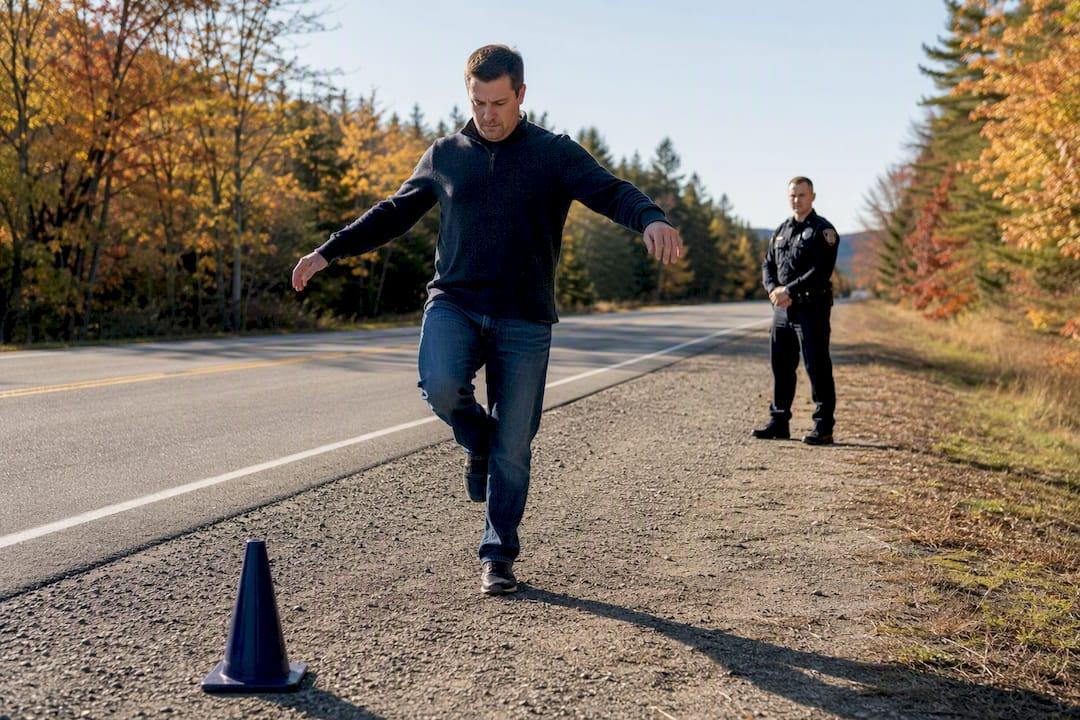
Roadside field sobriety tests in New Hampshire are voluntary. You can decline them. What isn’t voluntary, once you’re arrested, is the chemical test that follows under the state’s implied consent law. Refuse that one and you’re facing an automatic license suspension, not just a police officer’s opinion of your coordination. Stay calm, stay polite, decline the roadside tests if you choose to, and ask for an attorney the moment you’re in custody.
TL;DR:
- Refusing roadside field sobriety tests does not result in automatic penalties, but declining the post-arrest chemical test triggers license suspension under implied consent laws.
- The three scientifically validated field sobriety tests are the horizontal gaze nystagmus, walk-and-turn, and one-leg stand, each requiring strict adherence to standardized procedures for evidential weight.
- Conditions like uneven surfaces, poor lighting, footwear choice, or medical issues can invalidate test results, especially if documented and questioned by a defense attorney.
- Officers rely on a combination of observations and test clues to justify arrests, but deviations from standard procedures and environmental factors can undermine the evidence.
- Preserving medical records, scene photos, and witness accounts is crucial, as these details can significantly impact the strength of a defense against impairment charges.
Table of Contents
- What Are Field Sobriety Tests and Why Do Officers Use Them?
- What Do the Three Standardized Field Sobriety Tests Actually Measure?
- Are Field Sobriety Tests Mandatory in New Hampshire?
- How Do Officers Use FST Results to Justify an Arrest?
- What Should You Do During and After a DWI Stop?
- An Attorney’s View on Challenging FST Evidence
- Why the Standard Advice on FSTs Misses the Point
- How Granite Criminal Defense Handles Your DWI Case
- Key Statutes and Resources on FSTs in New Hampshire
- Sources
- FAQ
What Are Field Sobriety Tests and Why Do Officers Use Them?
Field sobriety tests are roadside exercises officers use to gather observable evidence of impairment before they decide whether to arrest you. They’re built into what law enforcement calls the three-phase DWI detection process:
- Vehicle-in-motion phase: officers watch your driving for weaving, speed changes, or delayed reactions before they ever pull you over.
- Personal contact phase: they observe your speech, eyes, and behavior during the initial conversation at your window.
- Pre-arrest screening phase: this is where the standardized field sobriety tests come in, along with a possible preliminary breath test.
None of this happens in a lab. You might be standing on a gravel shoulder in the dark, in dress shoes, with a bad knee, while a state trooper points a flashlight at your face. Officers are trained to know that surface, weather, footwear, age, and existing medical conditions can all mimic the signs they’re looking for. Whether they account for that in the moment is a different question, and it’s often the first thing a defense attorney checks.
What Do the Three Standardized Field Sobriety Tests Actually Measure?
Only three field sobriety tests carry any real scientific backing, and they’re the ones taught nationwide through the NHTSA/IACP standardized field sobriety test curriculum. Anything outside these three (reciting the alphabet backward, touching your nose) is non-standardized and carries far less weight in court.
- Horizontal Gaze Nystagmus (HGN): the officer moves a stimulus, usually a pen, side to side and watches your eyes for involuntary jerking. Clues include lack of smooth pursuit, distinct jerking at maximum deviation, and onset of jerking before a 45-degree angle. Alcohol amplifies this reflex, which is why HGN is generally viewed as the most reliable of the three when administered correctly.
- Walk-and-turn: a divided-attention test where you walk nine steps heel-to-toe along a line, turn, and walk back. Officers score clues like losing balance during instructions, stepping off the line, using arms for balance, or an improper turn.
- One-leg stand: you hold one foot six inches off the ground for 30 seconds while counting aloud. Swaying, hopping, putting the foot down, or using arms for balance all count against you.
The SFST Participant Manual lays out the exact administration steps and the validated clue counts behind each test. That manual matters more than most drivers realize: if the officer skipped a step or scored a clue that isn’t in the validated list, that deviation becomes a real point of attack later.
Are Field Sobriety Tests Mandatory in New Hampshire?
Not at the roadside. You can decline the walk-and-turn, the one-leg stand, and the HGN without facing an automatic penalty for that refusal alone. The distinction that trips people up is between these voluntary tests and what comes next.
- Roadside FSTs: voluntary. Declining them doesn’t trigger license suspension on its own, though it may still factor into the officer’s probable cause decision.
- Preliminary breath test (PBT): officers can request this before an arrest. Refusing it generally can’t be used against you at trial except to help establish whether probable cause existed for the arrest itself.
- Post-arrest chemical test: this is where implied consent takes over. Under RSA 265-A:4, anyone arrested for suspected DWI is deemed to have already consented to a blood, breath, or urine test. The legal limit is 0.08% BAC for drivers 21 and older, and 0.02% for drivers under 21.
Refuse that post-arrest test and RSA 265-A:14 kicks in: a first refusal triggers a license suspension of several months, and a prior DWI conviction or prior refusal can lead to a longer suspension period. That penalty applies whether or not you’re ultimately convicted of the DWI itself.
How Do Officers Use FST Results to Justify an Arrest?
Officers stack their observations. Bloodshot eyes, an odor of alcohol, slurred speech, and poor performance on the standardized tests combine into what they document as probable cause for arrest. No single clue is usually enough on its own. The cumulative picture is what gets written into the report.
That cumulative approach is also where the tests fall apart under scrutiny. Common problems include:
- Testing on uneven pavement, gravel shoulders, or sloped surfaces never designed for balance testing
- Poor lighting, wind, or rain during administration
- Footwear (heels, boots) that the officer never accounted for
- Undisclosed medical conditions: inner ear disorders, arthritis, prior leg or back injuries
- Officers deviating from the standardized scoring criteria in the SFST manual
Pro Tip: If you have a medical condition that could affect your balance or eye movement (vertigo, a knee replacement, a neurological condition), get that documented with your doctor as soon as possible after the arrest. Early medical records carry far more weight than a claim made months later in court.
A defense attorney’s first move is usually requesting the officer’s training and certification records, along with dash-cam or body-cam footage, to compare what actually happened against the standardized procedure.
What Should You Do During and After a DWI Stop?
- Stay calm and polite. Provide your license, registration, and proof of insurance. That’s required. Answering questions about how much you drank is not.
- Decide on the FSTs. You can decline the standardized tests. Do it politely and without physical resistance, whatever you decide.
- If you’re arrested, ask for an attorney immediately. Don’t volunteer explanations or theories about why you failed a test.
- Request the written breath test results once you’re processed, if a chemical test was administered.
- Document everything afterward. Note the lighting, the surface you stood on, your footwear, the officer’s name and badge number, and the patrol vehicle number. If you have a medical condition, get it on record with a doctor right away.
An Attorney’s View on Challenging FST Evidence
A skilled criminal defense firm treats every FST-based arrest as a paper trail waiting to be pulled apart. That starts with the officer’s SFST certification and training history, then moves to whatever video exists, since body-cam footage frequently contradicts what’s written in the arrest report.
Poor balance on a gravel shoulder at midnight isn’t proof of impairment. It’s proof someone asked a person to do a balance test in conditions no sober person could pass cleanly either.
Medical records, prescription histories, and documented injuries routinely change how a prosecutor evaluates a case, especially when introduced before charges are finalized rather than after. How aggressively a case gets litigated often depends on whether it’s a first offense or there’s a prior record on the books, which changes what’s actually at stake for the client.
Why the Standard Advice on FSTs Misses the Point
Most articles on this topic stop at “you can refuse the tests,” as if that’s the whole story. It isn’t. The real leverage point isn’t whether you refused. It’s whether the state can prove the test that was administered actually followed the NHTSA-validated procedure, on a surface and in conditions that make the results meaningful.
Drivers fixate on the refusal decision because it feels like the one moment of control they have. Fair enough. But the bigger mistake happens after the arrest: staying quiet about a bad knee, an inner ear issue, or the ice patch nobody photographed. Those details expire fast. Memory fades, scenes change, and by the time a case reaches an attorney’s desk, weeks or months later, the physical evidence that would have undercut the officer’s account is often gone.
Prioritize documentation over defiance. Getting a medical note or a photo of the shoulder you stood on matters more than any argument you have with the officer at 1 a.m. That’s the piece conventional advice leaves out, and it’s usually the piece that actually moves a case.
— Rich
How Granite Criminal Defense Handles Your DWI Case
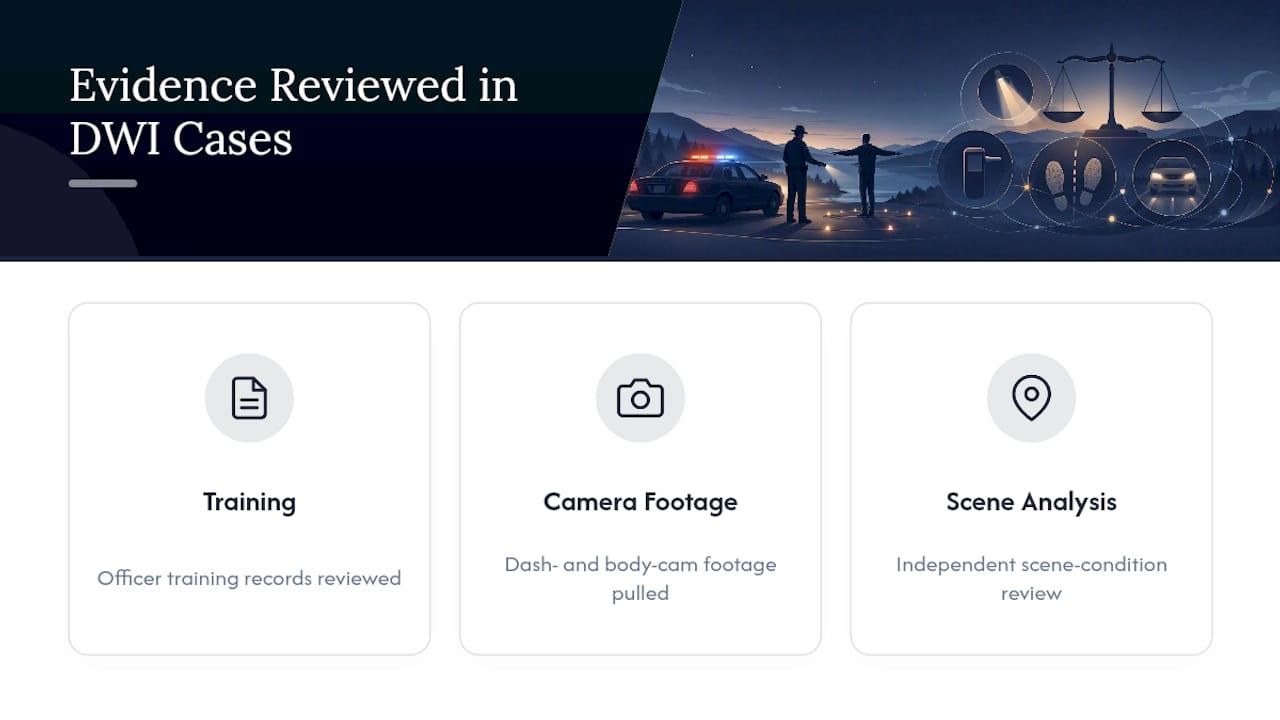
If you’re facing a DWI charge in New Hampshire, the strength of your defense usually comes down to details most drivers never think to preserve, especially when serious factors like injuries are involved, which can affect bail eligibility as explained in DUI With Injury and Bail in California. A defense firm typically reviews the officer’s training records, pulls dash-cam and body-cam footage, and runs an independent look at the scene conditions that a police report alone won’t capture.
A first consultation covers what actually happened at the stop, what evidence exists so far, and a realistic read on your timeline and options, whether that means fighting the charge outright or negotiating it down. Some firms handle DWI defense alongside felony and misdemeanor cases with an evidence-first approach.
If you were arrested after a field sobriety test in New Hampshire, get in touch with Granite Criminal Defense for a case review before you talk to anyone else about what happened.
Key Statutes and Resources on FSTs in New Hampshire
- RSA 265-A:4: implied consent and BAC limits
- RSA 265-A:14: refusal penalties
- NHTSA SFST resources: test validation and training
- NH DMV suspension pages: administrative process
This article is general information, not a substitute for advice from a qualified lawyer. Consult a qualified legal professional about your own circumstances before acting on anything here.
Sources
- Chapter 265-A – Alcohol or Drug Impairment (NH Revised Statutes) — RSA 265-A:4
- DWI Detection and Standardized Field Sobriety Test (SFST) Resources | NHTSA
- NH DMV — Suspension and restoration
FAQ
Can I Refuse a Field Sobriety Test in New Hampshire?
Yes, roadside FSTs like the walk-and-turn and one-leg stand are voluntary, and refusing them doesn’t trigger an automatic penalty on its own. Refusing a post-arrest chemical test is different: that triggers a license suspension under RSA 265-A:14.
What Are My Legal Rights During a Field Sobriety Test?
You have the right to decline the standardized roadside tests, the right to remain silent about anything beyond your license and registration, and the right to request an attorney once you’re placed under arrest.
Is a DWI a Felony in New Hampshire?
A first or second DWI is typically charged as a misdemeanor, but repeat offenses, injury or death involved, or aggravated circumstances can elevate the charge to a felony. If you’re unsure how your situation is classified, a firm like Granite Criminal Defense can review the specifics of your arrest.
Can a Passenger Drink Alcohol in a Car in New Hampshire?
New Hampshire’s open container laws restrict open alcohol containers in the passenger area of a vehicle on public roads, regardless of whether the person drinking is the driver or a passenger. The rules get more specific depending on vehicle type and whether the vehicle is parked, so check the exact statute or ask an attorney if your situation isn’t clear cut.
What Happens if I Fail a Field Sobriety Test?
Failing an FST gives the officer grounds to argue probable cause for arrest, but it isn’t automatic proof of impairment in court. The validated clues an officer records can still be challenged based on how the test was administered and the conditions you were tested under.
