
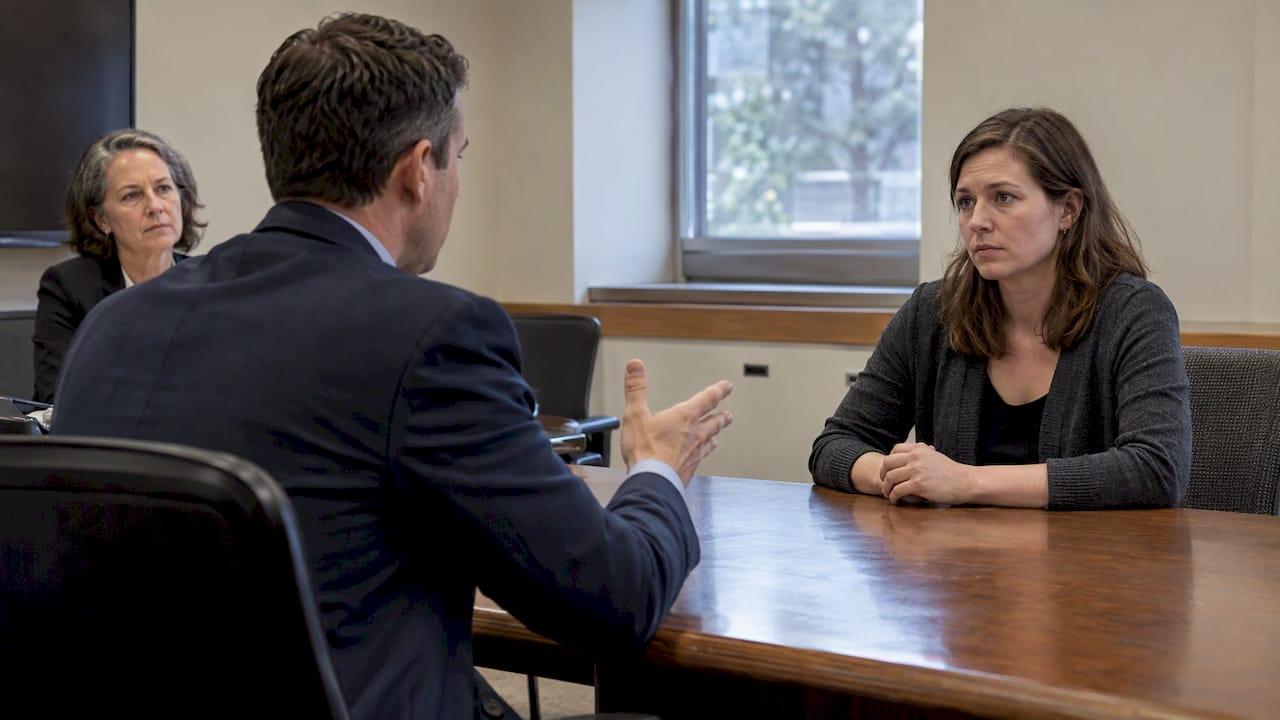
Under current Title IX rules, postsecondary hearings must allow advisor-led cross-examination in real time, and decision-makers must rule on relevance before questions get answered. If a party or witness refuses to submit to that questioning, the decision-maker generally cannot rely on their prior statements when deciding responsibility. These two mechanics, live advisor questioning and automatic exclusion of untested statements, drive nearly every strategic decision in a campus hearing.
TL;DR:
- Schools must provide an advisor at no cost when a party lacks one; the advisor may be a nonlawyer but alone conducts questioning.
- Questions about sexual predisposition are barred; prior sexual behavior is allowed only to identify another perpetrator or establish consent through specific incidents with the respondent.
- A party or witness who answers some questions is treated as refusing cross examination, so none of that person’s statements may support a responsibility finding.
- Police reports, medical records, and investigator summaries may remain in evidence, but statements from a nonparticipating witness inside them cannot be relied on to decide responsibility.
- When competing accounts make credibility decisive, involve experienced Title IX counsel early and prepare questions around the fact each one proves and its relevance basis.
Table of Contents
- What the regulations require: live hearings, advisor role, and real-time mechanics
- Limits on questioning: relevance rules and rape-shield protections
- What happens if a party or witness refuses cross-examination
- Hearing procedures and decision-maker responsibilities
- Due process and case law: what courts have said about meaningful cross-examination
- Practical preparation: what parties and advisors must do before cross-examination
- Balancing truth-seeking and fairness in Title IX hearings
- How a criminal defense firm supports Title IX hearings
- FAQ
- Sources
What the regulations require: live hearings, advisor role, and real-time mechanics
Postsecondary schools must hold a live hearing where each party’s advisor, not the party themselves, asks the other party and any witnesses relevant questions directly, orally, and in real time. This requirement comes from 34 C.F.R. § 106.46, which sets out the grievance procedures implementing the broader cross-examination mandate, and from guidance explaining the real-time relevance process. Before a question can be answered, the decision-maker has to rule on whether it’s relevant.
K through 12 institutions operate under a different standard: live hearings are optional there, while postsecondary schools have no such flexibility.
A few structural points matter for anyone preparing for a hearing:
- Parties never question each other directly. All cross-examination runs through an advisor.
- If a party shows up without an advisor, the school must provide one free of charge, specifically for the purpose of conducting cross-examination.
- Advisors don’t have to be attorneys, but the role carries real procedural weight since the party has no alternative way to test the other side’s account.
Limits on questioning: relevance rules and rape-shield protections
Not every question an advisor wants to ask will survive a relevance ruling. The rule builds in rape-shield style protections that function much like evidentiary limits in criminal court, excluding most questions about a complainant’s prior sexual history or behavior with other people.
- Questions about a complainant’s sexual predisposition are irrelevant and must be excluded.
- Questions about prior sexual behavior are excluded unless offered to prove someone other than the respondent committed the alleged conduct, or to prove consent based on specific incidents involving the respondent and complainant.
- Decision-makers must explain, on the record, why an excluded question was excluded.
These exceptions are narrow by design, and schools commonly publish their own implementation of the standard, as in this model relevance policy. When a question gets excluded, the rule still gives the asking party a chance to revise or clarify it rather than losing the line of inquiry outright.
Pro Tip: Draft every cross-examination question with its relevance exception stated in one sentence beforehand, so you can argue it immediately if the decision-maker balks.
What happens if a party or witness refuses cross-examination
The consequence of refusing to submit to cross-examination is specific and limited. The decision-maker must exclude that person’s statements from the responsibility determination, but cannot treat the refusal itself as proof of anything.
If a party or witness does not submit to cross-examination at the live hearing, the decision-maker must not rely on any statement of that party or witness in reaching a determination regarding responsibility; the decision-maker cannot draw an inference about the determination regarding responsibility based solely on a party’s or witness’s absence from the live hearing or refusal to answer cross-examination.
This also governs partial answers: answering some relevant questions but not others still counts as not submitting to cross-examination for that witness’s full statement. Police reports, medical records, and investigator summaries can still enter the record, but any statement embedded in them from someone who skips the hearing loses its evidentiary weight at the responsibility stage.
Hearing procedures and decision-maker responsibilities
A live hearing follows a fairly predictable sequence, even though institutions vary in logistics.
- The decision-maker opens the hearing and confirms both parties and their advisors are present or appearing remotely.
- Each party presents relevant evidence, often through opening statements or direct testimony.
- Advisors for each party cross-examine the other party and witnesses, one question at a time, with the decision-maker ruling on relevance before each answer.
- When a question is excluded, the decision-maker explains why and gives the advisor a chance to revise or clarify it.
- The decision-maker closes the hearing and moves to deliberation.
Most schools offer accommodations such as separate rooms with live video feeds so parties never have to be physically present with each other, and some permit screen-only participation for witnesses. Written-only answers generally don’t satisfy the live cross-examination requirement, since the rule is built around real-time questioning rather than submitted responses.
Due process and case law: what courts have said about meaningful cross-examination
Federal courts had already been wrestling with cross-examination rights before the current regulatory text existed, and their reasoning still shapes how schools and advisors think about fairness.
- In Haidak v. University of Massachusetts-Amherst, the First Circuit held that due process requires a meaningful opportunity to respond when credibility drives the outcome, though it stopped short of requiring unlimited party-conducted questioning.
- The Sixth Circuit’s Doe v. Baum line of cases has pushed further, emphasizing that when a case comes down to competing, irreconcilable accounts, some form of live, adversarial testing of credibility becomes essential to a fair process.
- The consistent thread: the more a case hinges on who is telling the truth rather than on undisputed facts, the stronger the expectation that cross-examination will be real, not symbolic.
For advisors and parties, the practical lesson is straightforward. When a hearing is going to turn on competing narratives, expect decision-makers and reviewing courts to scrutinize whether cross-examination actually tested the weak points in each account.
Practical preparation: what parties and advisors must do before cross-examination
Preparation determines whether cross-examination produces something useful or just burns time.
- Gather text messages, emails, medical records, and any documentary evidence early, and organize it so it stays usable even if a witness never testifies.
- Draft direct questions tied to a specific fact you need established, and prepare fallback phrasing in case the first version gets excluded on relevance grounds.
- Rehearse delivery with an advisor, focusing on calm, trauma-informed phrasing that avoids argumentative tone, since decorum violations can derail a line of questioning entirely.
- Loop in experienced Title IX counsel early when the case will likely come down to credibility, since that’s exactly the scenario courts and decision-makers scrutinize most closely.
Pro Tip: Build a one-page question map before the hearing, each question paired with the fact it proves and the relevance exception it relies on, so nothing gets asked without a ready justification.
Balancing truth-seeking and fairness in Title IX hearings
Cross-examination exists to test credibility, not to punish anyone for showing up. Institutions carry real responsibility for running hearings where questioning stays rigorous but doesn’t become a second trauma for anyone involved. The sharpest advisors I’ve seen treat decorum and relevance rules as tools for better fact-finding, not obstacles to work around. When a case is going to live or die on whose account a decision-maker believes, getting counsel involved early changes the outcome more than almost anything else in the process.
— Walter Ramos
How a criminal defense firm supports Title IX hearings
Preparing for a Title IX hearing where cross-examination will decide the outcome takes the same rigor as preparing for trial, and that’s how we approach every UNH Title IX investigation and hearing we handle. We build out evidence early, draft and rehearse cross-examination questions against the relevance rules, and coordinate directly with advisors to reduce preventable errors. Because we prepare cases thoroughly, our clients walk into hearings with a tested strategy rather than a last-minute scramble. If you’re facing a university disciplinary proceeding, reach out through our practice areas page to talk through your situation.
This article is general information, not a substitute for advice from a qualified lawyer. Consult a qualified legal professional about your own circumstances before acting on anything here.

FAQ
How serious is a Title IX violation?
A Title IX violation can lead to suspension, expulsion, or a permanent disciplinary record, consequences that can follow a student into transfer applications, graduate admissions, and licensing boards. The seriousness depends on the specific findings and the institution’s own sanction guidelines, which vary by school.
What can you not ask in cross-examination?
Questions about a complainant’s sexual predisposition are always excluded, and questions about prior sexual behavior with people other than the respondent are excluded unless they fit a narrow exception under the Title IX relevance rules. Decision-makers also exclude questions that are clearly unclear, harassing, or repetitive once already answered.
What are the three C’s of cross-examination?
This phrase isn’t a recognized standard under Title IX regulations or Department of Education guidance, and definitions vary widely depending on the source. Rather than relying on an informal mnemonic, advisors preparing for a Title IX hearing should build questions around relevance, clarity, and the specific fact each question is meant to establish.
What are the three requirements of Title IX?
Title IX itself is a short civil rights statute, and its implementing regulations, particularly 34 C.F.R. § 106.46, set out the detailed procedural requirements schools must follow, including live hearings, advisor-led cross-examination, and real-time relevance rulings. There isn’t an official “three requirements” framework; the regulations instead lay out a full grievance process covering notice, investigation, and hearing procedures.
Sources
- Cross-examination and relevancy (Knowmore/FSU guidance on Title IX)
- Questions and Answers Regarding the Department’s Final Title IX Rule (OCR Q&A)
- 34 C.F.R. § 106.46 — Grievance procedures for postsecondary institutions
