

A DWI conviction stays on your New Hampshire driving record for 10 years, and state law bars any court from annulling a DUI-related conviction until 10 years after the conviction date under RSA 265-A:21. That clock doesn’t start until you’ve finished every part of your sentence, including fines and required programs. Aggravated charges, multiple counts from one arrest, or unpaid obligations can push the timeline back further.
TL;DR:
- A DWI stays on your New Hampshire driving record for 10 years from the conviction date, starting only after completing all sentence obligations.
- To qualify for annulment after 10 years, you must complete every part of your sentence, wait the full 10 years, and have no subsequent disqualifying offenses.
- Multiple charges from one arrest or aggravated DWI cases can extend mandatory waiting periods and complicate the annulment process.
- While a conviction remains on your record, license restrictions, higher insurance premiums, and background checks may still impact you.
- Filing errors, incomplete documentation, or recent charges can lead to rejection or additional delays beyond the 10-year minimum.
Table of Contents
- How Long a DUI Stays on Your Driving Record in NH
- Criminal-Record Duration and Annulment Eligibility Under New Hampshire Law
- Exceptions That Change Your Timeline
- What You Live With While the Conviction Is Active
- How to Petition for Annulment in New Hampshire
- Next Steps: Checking Your Eligibility Date
- Firm Perspective: Annulment Is Statutory, Not Automatic
- How Granite Criminal Defense Can Help
- Sources
- FAQ
How Long a DUI Stays on Your Driving Record in NH
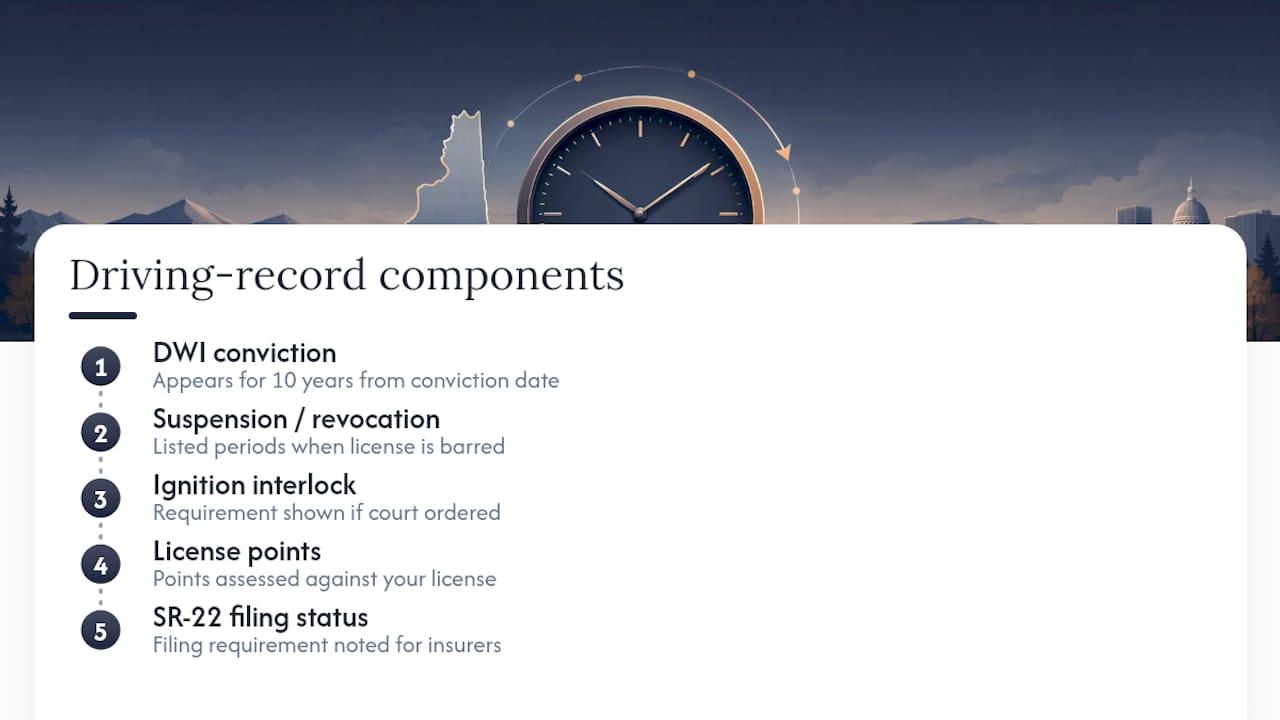
Your driving record and your criminal record are two different files, and they don’t clear on the same schedule or for the same reasons. The Department of Motor Vehicles maintains the driving history that insurers, employers who run motor vehicle checks, and courts pull when they need to see your history behind the wheel. A DWI entry sits on that record for 10 years from the conviction date, matching the same 10-year window that governs annulment eligibility.
The driving record shows more than just the conviction. It typically includes details like suspension or revocation periods, ignition interlock requirements if ordered, points assessed against your license, and filing status such as SR-22 if required by your insurer. Insurers generally consider a DWI a serious mark that affects premiums, regardless of subsequent criminal case developments.
Criminal-Record Duration and Annulment Eligibility Under New Hampshire Law
Your criminal record works differently than your driving history, and this is where most people get confused. RSA 265-A:21 states plainly that no court can annul a DWI-related conviction until 10 years have passed since the conviction date. That’s a hard statutory floor. No judge has discretion to waive it, no matter how clean your record has been since.
Once you clear that 10-year bar, RSA 651:5 governs the actual annulment process for New Hampshire offenses generally. This statute sets different waiting periods depending on offense classification, ranging from 1 year for certain violations up to 10 years for the most serious charges. For DUI specifically, the 10-year figure in RSA 265-A:21 controls.
Here’s what eligibility actually requires, in order:
- Complete every term of your sentence, including probation, fines, and any court-ordered program
- Wait the full 10 years from your conviction date, not your arrest date
- Confirm you have no disqualifying subsequent offenses during that window
- File the correct petition form with the court that handled your case
- Survive the prosecutor’s 20-day objection period without a successful challenge
Even after a successful annulment, the record doesn’t vanish completely. Courts keep annulled convictions in a restricted permanent file for sentencing purposes, meaning a judge in a future case can still see it existed even though it’s cleared from public and most employment-facing checks.
Exceptions That Change Your Timeline
Not every case follows the standard 10-year path cleanly. A few situations complicate things:
- Multiple charges from one arrest. If your arrest produced several convictions, you must satisfy the longest waiting period among all of them before filing anything. Filing before every charge clears risks outright denial.
- Aggravated DWI. These charges carry longer mandatory revocation periods and stricter ignition interlock rules under Chapter 265-A, and the underlying conviction still falls under the same 10-year annulment bar.
- Plea reductions. A DWI reduced to a lesser charge through plea negotiation may change what shows on your criminal record, but it won’t necessarily shorten the driving-record entry if the DMV still codes it as an impaired-driving violation.
- Denied petitions. If a judge denies your annulment request, you typically face a three-year wait before you can refile, so filing too early carries real cost.
What You Live With While the Conviction Is Active
Until you reach eligibility and successfully annul, a DWI conviction follows you in several concrete ways. License consequences hit first: revocation periods vary by offense level under Chapter 265-A, and many convictions trigger mandatory ignition interlock installation before driving privileges are restored.
Insurance is where most people feel the pinch longest. New Hampshire’s SR-22 filing requirement applies after certain convictions, and insurers usually charge sharply higher premiums for years after a DWI, sometimes long after the SR-22 requirement itself expires.
Employment and background checks are the third pressure point:
- Many employers run background checks that surface unannulled convictions for the full time they remain on record
- Federal background checks (for security clearances, certain licenses, or federal employment) can surface convictions differently than state-level checks, and annulment doesn’t always erase a record from federal databases the way it does from New Hampshire state systems
- Landlords and licensing boards may ask directly about convictions, and an annulled record generally lets you answer “no” under New Hampshire law
Pro Tip: Start tracking your exact sentence-completion date now, even if annulment is years away. Courts calculate your 10-year window from that completion date, not your arrest, and getting it wrong by even a few months can mean a wasted filing and a three-year penalty for refiling.
How to Petition for Annulment in New Hampshire
Once you’ve cleared the 10-year bar, the filing process itself is procedural but unforgiving of mistakes. The court’s annulment checklist walks through form selection and documentation, and it’s worth reading before you file anything.
- Identify the correct form. Convictions before January 1, 2019 use a different petition form than convictions after that date. Filing the wrong version can delay or derail your case.
- File with the sentencing court, not just any courthouse in your county.
- Expect the court to pull reports from the Department of Corrections and the Department of Safety to verify your record and confirm sentence completion.
- Pay the associated fees. RSA 651:5 references a $100 charge tied to Department of Corrections reporting and a separate $100 fee from the Department of Safety for updating criminal history records after a successful annulment, with exceptions for petitioners who qualify as indigent.
- Wait through the prosecutor’s objection window. The state has 20 days to object once your petition is filed.
| Step | Typical Timeframe |
|---|---|
| Confirm sentence completion date | Immediately upon verification |
| File petition with correct form | Day of filing |
| Prosecutor objection window | Statutorily up to 20 days |
| Court review and decision | Variable, can take weeks to months |
Bring certified copies of your case disposition, proof every fine and fee was paid, and documentation of any program completion. Incomplete records are one of the most common reasons prosecutors object.
Next Steps: Checking Your Eligibility Date
Before filing anything, get your facts straight. Order a certified copy of your case disposition from the court that handled your conviction, and pull your driving history directly from the DMV to confirm what’s actually showing.
- Request certified court records to nail down your exact conviction and sentence-completion dates
- Cross-check that date against the 10-year requirement in RSA 265-A:21
- Consider hiring counsel if your case involved multiple charges, an aggravated DWI, or if you’re unsure how a plea reduction affected your record
- Talk to an attorney before filing if you’re within a year of eligibility, since a rejected petition costs you three more years
An attorney handling this regularly knows how to assemble a petition that survives a prosecutor’s objection, which matters more than most people expect going in.
Firm Perspective: Annulment Is Statutory, Not Automatic
People assume that once the 10-year clock runs out, annulment is a formality. It isn’t. The statute sets eligibility, but a judge still has to grant relief, and prosecutors object more often than most petitioners expect, especially when documentation is thin or a later charge complicates the picture. We’ve built our approach around treating every petition as if it will be contested, because often it is. Get your paperwork in order early, and talk to counsel well before your eligibility date arrives, not after a denial forces a three-year wait.
— Rich
How Granite Criminal Defense Can Help
Experienced attorneys can provide DUI defense and record annulment assistance, including guidance from former prosecutors familiar with the process. That means we know exactly what makes a prosecutor object to an annulment petition, and we build filings to withstand that scrutiny from the start. Services may include eligibility review, gathering required documentation, petition drafting, and court representation if needed.
If you’re still facing an active DUI charge, our DUI defense attorneys can start building your case today. If you’re approaching your 10-year annulment window, reach out through our contact page to get your eligibility date confirmed and your paperwork started before that clock becomes a problem.

This article is general information, not a substitute for advice from a qualified lawyer. Consult a qualified legal professional about your own circumstances before acting on anything here.
Sources
- 265-A:21 Annulment; Plea Bargaining. — New Hampshire Revised Statutes
- Annulment of criminal records: court checklist — New Hampshire Judicial Branch
FAQ
Will a DUI Show Up on a Background Check After 20 Years?
If the conviction was never annulled, it can still appear on many background checks indefinitely, since New Hampshire’s driving-record clearing period only covers the DMV file, not every third-party database. Annulment removes it from most state-level checks, but federal background checks may still surface it depending on the system queried.
What Are the Consequences of a First-Time DUI Offense in New Hampshire?
A first offense typically brings fines, license revocation, and possible ignition interlock requirements, with specifics laid out in Chapter 265-A. For a breakdown of exact fines and the steps that follow a first arrest, see our guide on first-offense DUI penalties.
How Much Does It Cost to Expunge Your Record in NH?
New Hampshire uses annulment rather than expungement, and the process involves a $100 fee for Department of Corrections reporting plus a $100 fee for the Department of Safety to update your record, per RSA 651:5, with exceptions for petitioners who qualify as indigent.
Do You Lose Your License Immediately After a DUI in New Hampshire?
Yes, in most cases license suspension or revocation begins administratively at arrest or shortly after conviction, separate from any criminal court proceedings, and the length depends on whether the offense involved aggravating factors under Chapter 265-A.
Can You Annul a DUI Conviction Before 10 Years Have Passed?
No. RSA 265-A:21 sets a firm 10-year floor from the conviction date, and no court has discretion to shorten that period for a DUI-related offense.
