

A single, first-time DUI rarely triggers automatic deportation on its own, but it is never immigration-neutral. Multiple DUIs, injury, drugs, or a suspended license can push a case into deportability, inadmissibility, or a denial of naturalization under USCIS Policy Manual — Volume 12, Part F, Chapter 5 and the precedent set in Matter of Castillo-Perez. Talk to both a criminal defense lawyer and an immigration attorney before you agree to any plea, and keep every piece of paperwork from the arrest forward.
TL;DR:
- Multiple DUIs during the relevant period create a rebuttable presumption that an applicant lacks good moral character for naturalization, requiring credible evidence to rebut.
- Serious aggravating factors such as injury, death, drug involvement, or repeat offenses can transform a DUI into a crime that risks deportation or inadmissibility.
- A recent DUI can trigger medical inadmissibility reviews, especially if there are patterns like injury, high blood alcohol levels, or if the arrest was within specific recent timeframes.
- Even a single DUI without aggravating facts generally does not cause deportability but may complicate visa renewals, reentry, or green card adjustments.
- Coordinating early plea negotiations with both criminal and immigration attorneys significantly influences future immigration consequences and should occur before plea agreements are finalized.
Table of Contents
- Immigration Consequences of DUI: Deportability, Inadmissibility, and Good Moral Character
- Aggravating Factors That Turn a DUI Into a Removal Risk
- Can a DUI Trigger a Medical Inadmissibility Review?
- How a DUI Affects Green Card Renewal and Naturalization Timing
- What Relief Options Exist After a DUI?
- What to Do Immediately After a DUI Arrest
- Why State Sentencing Details Change the Federal Immigration Outcome
- Granite Criminal Defense: How We Handle DUI Cases With Immigration Exposure
- How Does a DUI Affect Different Visa Categories?
- Do Green Card Holders Face Risks Beyond Deportation?
- Can a DUI Arrest Without a Conviction Still Hurt Your Status?
- Why Coordinated Criminal and Immigration Counsel Matters
- How Can a DUI Delay or Derail Naturalization?
- Does a DUI Affect Asylum Seekers and Refugees?
- What This Guide Gets Right That Most Advice Misses
- Need Help Now? Contact Granite Criminal Defense
- Primary Sources and Further Reading
- Sources
- FAQ
Immigration Consequences of DUI: Deportability, Inadmissibility, and Good Moral Character
Immigration law sorts consequences into three separate buckets, and a DUI can land in more than one at the same time. Deportability applies to people already admitted to the U.S. (green card holders, visa holders) and asks whether a conviction gives the government grounds to remove them. Inadmissibility applies at the border, at a visa interview, or when someone applies to adjust status. Good moral character (GMC) is a separate standard tied to naturalization, cancellation of removal, and some waivers.
A single simple DUI, without aggravating facts, usually does not meet the bar for deportability under INA Section 237. It can still cause problems at a visa interview or reentry, because consular officers and border agents have wide discretion to flag alcohol-related arrests.
Multiple DUIs change the calculation entirely. Under Matter of Castillo-Perez, two or more DUI convictions during the relevant statutory period create a rebuttable presumption that the applicant lacks good moral character.
What this means in practice:
- One DUI without aggravating factors usually does not trigger deportability, but it can still complicate visa renewal or green card interviews.
- Two or more DUIs during the statutory period create a rebuttable presumption that an applicant lacks good moral character for naturalization, cancellation of removal, and similar discretionary benefits.
- The presumption is rebuttable, but USCIS requires substantial, credible evidence, not just a certificate of completion from a court program.
The rebuttable presumption rule: Two or more DUI convictions inside the statutory GMC period shift the burden onto the applicant to prove the offenses were an aberration, according to USCIS guidance on Good Moral Character.
Aggravating Factors That Turn a DUI Into a Removal Risk
Certain facts convert an ordinary DUI into something immigration officers treat far more seriously, sometimes reclassifying it as a crime involving moral turpitude (CIMT) or even an aggravated felony.
- Bodily injury or death. A DUI causing injury moves the case toward crimes of violence classification and often draws felony charges, which sharply raises deportation risk, according to AllLaw’s analysis of deportability versus inadmissibility.
- Driving on a license suspended for a prior alcohol offense. This pattern is one of the specific triggers USCIS lists for medical re-examination.
- Drug involvement (DUID or combined DUI/drug charges). Controlled substance issues carry their own, often harsher, immigration grounds independent of the DUI itself.
- Felony-level DUI under state law. Sentence length, not the charge label, drives federal immigration treatment.
- Very high BAC or repeat offenses within a short window. These patterns feed directly into the “habitual drunkenness” standard that can block a finding of good moral character.
An injury DUI, for instance, can also affect bail eligibility and pretrial release conditions, as outlined in this breakdown of DUI with injury cases, which matters because pretrial custody time can shape plea leverage.
Can a DUI Trigger a Medical Inadmissibility Review?
Yes. USCIS treats alcohol use disorder as a possible basis for medical inadmissibility when it comes with “associated harmful behavior,” under USCIS Policy Manual — Volume 8, Part B, Chapter 7. A DUI arrest or conviction doesn’t automatically mean a disorder finding, but certain patterns prompt a civil surgeon to take a second look.
Common triggers for re-examination:
- One DUI conviction within the past five years.
- Two or more DUI convictions within the past ten years.
- Any DUI involving injury or death.
- An arrest or conviction for driving on a license already suspended for alcohol-related reasons.
A Class A medical finding of alcohol use disorder with harmful behavior can block adjustment of status or an immigrant visa until the condition is treated and reassessed, sometimes requiring a waiver.
Keeping treatment records and court paperwork on hand matters here. Civil surgeons and USCIS reviewers weigh documentation the original exam never saw, so a well-organized file can change the outcome of a second look.
How a DUI Affects Green Card Renewal and Naturalization Timing
USCIS evaluates good moral character over a defined statutory period before the naturalization application; DUIs during this period are scrutinized, while earlier offenses carry less weight though may still be considered.
What counts as a “conviction” for immigration purposes surprises a lot of people:
- A guilty plea or a plea of no contest, combined with some form of punishment, restraint, or penalty, usually counts, even without a formal finding of guilt.
- Deferred adjudication and certain diversion programs can still count as convictions under immigration law depending on how the plea was structured.
- Expungement after the fact typically does not undo the immigration consequence of the original disposition.
That last point traces back to Matter of Thomas and Thompson, where the Attorney General held that post-sentencing modifications generally do not erase the immigration significance of the original sentence, a standard USCIS has since built into its own policy guidance. A judge reducing your sentence years later, in other words, usually will not rewrite how immigration sees the case.
What Relief Options Exist After a DUI?
Relief exists, but eligibility is narrow and fact-specific, which is exactly why early legal coordination matters more than most people expect.
- 212(h) waivers can forgive certain inadmissibility grounds tied to criminal conduct, but they come with strict eligibility rules and do not cover every DUI scenario.
- Cancellation of removal may be available to some green card holders and long-term residents facing removal proceedings, depending on time in status and the nature of the conviction.
- Prosecutorial discretion in removal proceedings can sometimes pause or resolve a case short of deportation, particularly with strong equities like family ties or community record.
- Diversion and plea structuring on the criminal side, negotiated before any plea is entered, can sometimes avoid a disposition that counts as a “conviction” for immigration purposes at all.
Pro Tip: Never let a criminal defense plea deal get finalized without an immigration attorney reviewing the exact plea language first. The difference between “guilty” and certain diversion outcomes can decide whether you keep your status.
What to Do Immediately After a DUI Arrest
The first 48 hours set the tone for everything that follows, both in criminal court and with immigration.
- Do not accept any plea or diversion offer before speaking with an immigration attorney. Even a seemingly minor plea can count as a conviction under immigration law.
- Contact a criminal defense attorney and an immigration attorney together, or one firm coordinating both. Plea language needs review from both angles before you sign anything.
- Collect every document tied to the arrest: the charging paperwork, your DMV record, any prior driving history, and booking records.
- Save all sentencing and court paperwork, including probation terms, fines, and any required alcohol education or treatment program.
- Complete and document any court-ordered treatment, and keep certificates of completion. These records matter if USCIS ever questions good moral character or orders a medical re-exam.
Pro Tip: Build a single folder, physical or digital, with every DUI-related document from day one. Immigration cases can resurface years later, and missing paperwork is one of the most common reasons rebuttal evidence falls short.
Why State Sentencing Details Change the Federal Immigration Outcome
Federal immigration law applies what’s called the categorical approach: it looks at the elements of the state statute you were convicted under and your actual sentence, not the label your state gives the charge.
- Two states can call similar conduct a “misdemeanor DUI,” but one attaches a sentence range that federal law treats as felony-level for immigration purposes.
- A suspended sentence, a sentence “imposed,” and time actually served can all be read differently by an immigration judge than by a state court clerk.
- This is exactly where local counsel earns their fee. Comparing this DUI versus reckless driving guide for New Hampshire against your actual charge and sentence range with a lawyer who knows New Hampshire courts is worth the conversation before any plea.
Granite Criminal Defense: How We Handle DUI Cases With Immigration Exposure
Experienced criminal defense lawyers handle DUI cases where immigration status is on the line. The approach typically includes a full evidence review and independent investigation, with coordination of plea strategy alongside immigration counsel to avoid uninformed agreements. Bilingual support in English and Spanish may be provided. Bring your charging documents, DMV record, and any prior offense history to your first consultation, along with details from this first DUI in New Hampshire guide if it applies to your situation.
How Does a DUI Affect Different Visa Categories?
The impact varies sharply depending on which visa you hold, and the differences trip people up constantly.
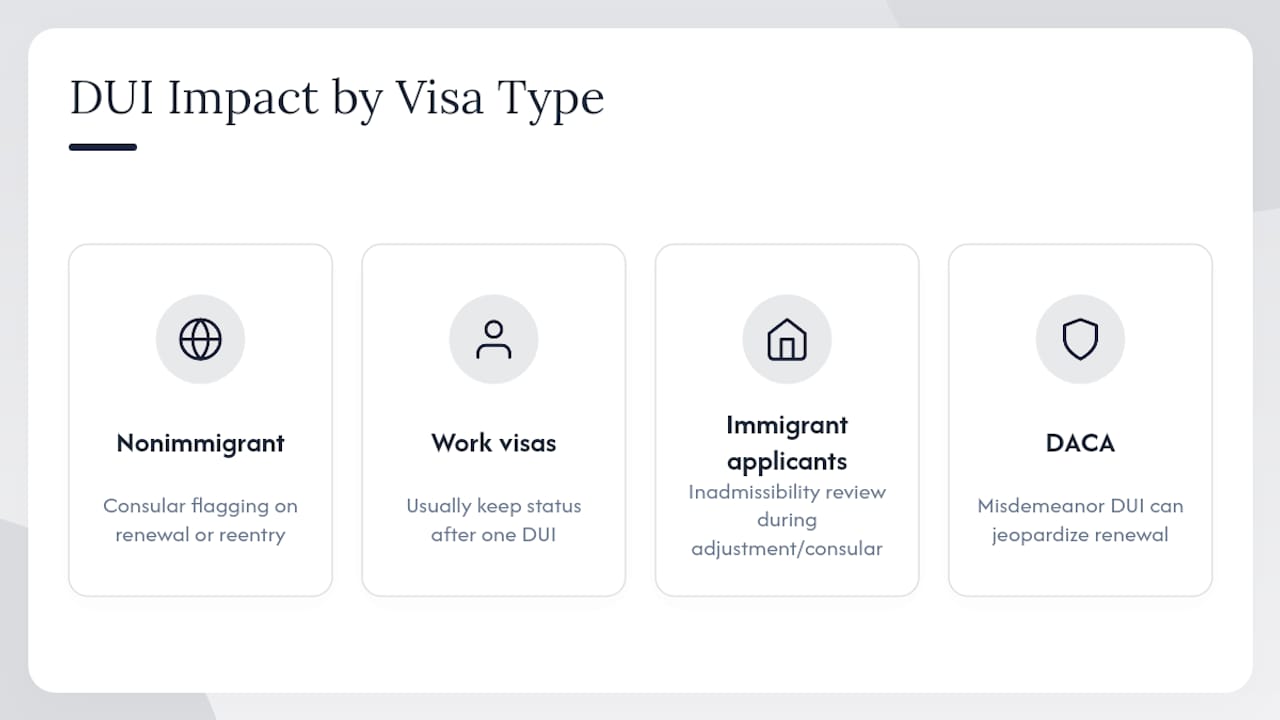
Nonimmigrant visa holders (tourist, student, work visas like H1B or F1) face the most immediate exposure at the consular level. A DUI arrest, even without conviction, can prompt a consular officer to flag the file for prudential revocation during a future visa renewal or reentry, according to reporting on consular practice around DUI and immigration consequences. Students on F1 status specifically risk both the immigration hit and a separate university disciplinary review, since most schools treat any arrest as reportable conduct.
Work visa holders (H1B, L1, TN) generally keep their status after a single DUI unless the employer’s compliance policies or the visa’s underlying conduct requirements are triggered, but the next visa renewal interview becomes noticeably harder. A pattern of DUIs, or one involving injury, can lead a consular officer to require additional documentation or a medical exam before approving renewal.
Immigrant visa applicants and green card seekers face inadmissibility review at the adjustment of status or consular processing stage, where a DUI history factors into both moral character analysis and, depending on pattern, medical evaluation.
DACA recipients occupy a particularly fragile position: even a misdemeanor DUI can jeopardize DACA renewal, since USCIS treats significant misdemeanors, DUI included, as a disqualifying category under current DACA guidelines.
A student facing this exact scenario should read this UNH student DUI checklist for the specific first steps that protect both academic standing and immigration status simultaneously.
Do Green Card Holders Face Risks Beyond Deportation?
Deportation gets the headlines, but permanent residents face a longer tail of consequences that show up years after the case closes.
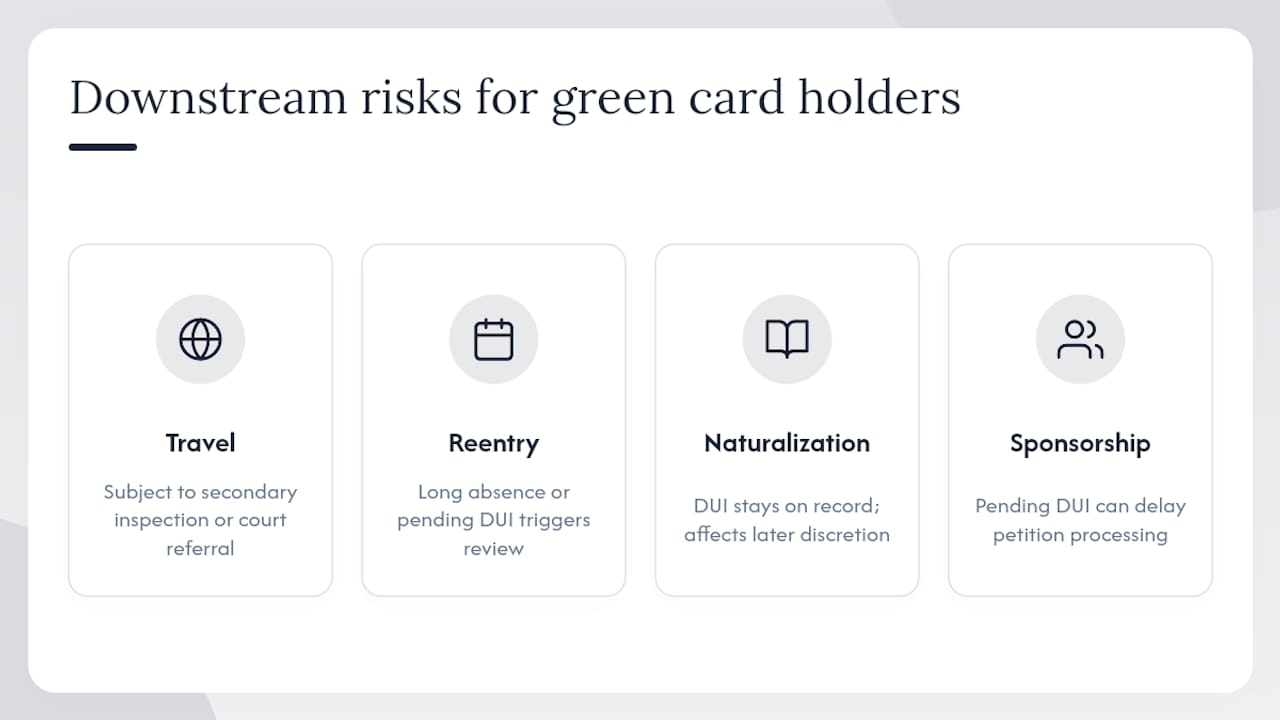
International travel becomes the first practical casualty. A green card holder returning from abroad with a DUI on record can be pulled into secondary inspection at the port of entry, questioned extensively, and in some cases referred to immigration court instead of simply waved through. That risk climbs sharply with multiple DUIs or any aggravating factor like injury.
Reentry after extended travel raises a separate issue: leaving the country for too long can be read as abandoning permanent resident status, and a DUI-related legal proceeding pending at the time of travel complicates that analysis further, since it can affect whether reentry gets treated as a routine return or a fresh admission subject to inadmissibility review.
Future naturalization applications carry the DUI forward indefinitely on the record, even after the statutory good moral character window closes. USCIS adjudicators can, and do, look at the full immigration and criminal history when evaluating discretion on later applications, including waiver requests or reentry permits.
Sponsoring family members can also stall. A pending DUI case or an unresolved moral character question can delay processing on petitions where the green card holder is the petitioner, since USCIS sometimes holds related filings until a criminal matter resolves.
None of this is automatic, but every one of these downstream effects starts with the same decision: how the original DUI case gets handled criminally. A plea negotiated without immigration input in year one can surface as a travel denial or a stalled petition in year five.
Can a DUI Arrest Without a Conviction Still Hurt Your Status?
Yes, and this catches a lot of people off guard. Immigration consequences are not limited to convictions. An arrest alone, documented in police and court records, can surface during any future immigration interaction and trigger extra scrutiny.
Consular officers routinely ask about arrests, not just convictions, on visa applications and during interviews. A DUI arrest that was dismissed, resolved through pretrial diversion, or never formally adjudicated as a conviction can still prompt a consular officer to request court disposition records, delay a visa decision, or refer the applicant for a medical evaluation under the alcohol use disorder framework.
Whether an arrest ultimately “counts” as a conviction for immigration purposes depends on specific criteria: a formal judgment of guilt, or a plea combined with some form of penalty or restraint on liberty. Diversion programs sit in a gray zone. Depending on how the program is structured and whether it required an admission of guilt, it may or may not meet the immigration definition of a conviction, according to legal analysis of DUI plea structures and immigration consequences.
This is precisely why the plea negotiation stage matters so much. An arrest that resolves through a program designed with immigration consequences in mind can avoid the conviction label altogether. One negotiated without that awareness can create a permanent mark, even when the criminal case itself ends favorably.
Why Coordinated Criminal and Immigration Counsel Matters
A criminal defense attorney’s job is to get the best outcome in criminal court. That is not always the same thing as the best outcome for immigration status, and the two goals can pull in different directions if nobody is watching both.
A criminal lawyer focused purely on minimizing jail time or fines might negotiate a plea that looks favorable on paper but technically meets immigration’s definition of a conviction, or carries a sentence length that crosses a felony threshold for immigration purposes even though the state calls it a misdemeanor. An immigration attorney, brought in early, can flag exactly which plea language, sentence structure, or program type creates the least immigration exposure, then hand that guidance back to the criminal defense team before anything is signed.
This coordination works best when it happens before arraignment, not after sentencing. Once a plea is entered and a sentence imposed, options narrow considerably, and Matter of Thomas and Thompson makes clear that going back to modify the sentence later usually will not undo the immigration consequence.
Firms handling both sides of a case, or maintaining close working relationships with immigration counsel, can move faster on this coordination than a defendant trying to line up two separate lawyers mid case. That single point of contact also reduces the risk of the classic breakdown: the criminal case resolving in a way immigration counsel would never have recommended, simply because nobody asked.
How Can a DUI Delay or Derail Naturalization?
A DUI inside the good moral character period doesn’t automatically end a naturalization case, but it commonly delays it while USCIS requests additional documentation, court records, and evidence of rehabilitation.
The most common delay pattern looks like this: an applicant files Form N400, USCIS flags a DUI during background review, and the case gets pulled for additional evidence, sometimes including a request for certified court dispositions, probation completion records, or a personal statement addressing the circumstances. This can add months to a case that would otherwise move on a standard timeline.
Two or more DUIs during the statutory period trigger the rebuttable presumption against good moral character. Overcoming that presumption requires more than a clean record since the offenses. USCIS wants credible evidence the DUIs were an aberration, not a pattern, which in practice often means character letters, proof of sustained sobriety or treatment completion, and a clear explanation of what changed. Simply waiting out the years and hoping the file looks better rarely satisfies the standard.
Outright denial becomes the real risk when the presumption isn’t rebutted, or when a DUI involved aggravating facts that raise separate deportability concerns. In some cases, filing for naturalization with an unresolved or recent DUI can expose the applicant to placement in removal proceedings instead of just a denial, particularly if the DUI reveals other status problems USCIS wasn’t previously aware of. That risk is one reason timing the naturalization filing itself, sometimes waiting until further outside the GMC window, is a strategic decision worth making with counsel rather than on your own.
Does a DUI Affect Asylum Seekers and Refugees?
Yes, and the stakes can be higher for this group because their underlying status is often more provisional to begin with. A pending asylum application generally survives a single DUI arrest, but the conviction becomes part of the discretionary record an immigration judge or asylum officer weighs when deciding the case.
Asylum, unlike some other forms of relief, involves significant discretion. Even when an applicant meets the legal definition of a refugee, a judge can deny asylum as a matter of discretion if the person’s criminal record, DUI included, suggests a pattern of disregard for the law. Aggravating factors like injury or multiple DUIs weigh far more heavily here than a single, resolved, first-time offense.
Refugees who already hold status face a related but distinct set of risks. A DUI conviction can affect adjustment of status to permanent residency, which most refugees pursue about a year after arrival, since that application involves its own admissibility and moral character review. A DUI during that window can delay adjustment or draw the same medical inadmissibility scrutiny that applies to other applicants, particularly if the arrest happened while the person was already on a suspended license or involved a high blood alcohol level.
Asylum seekers and refugees dealing with a DUI should treat immigration counsel as non-negotiable before any criminal court date, since the discretionary nature of asylum relief leaves far less room for error than in more clearly defined visa categories.
What This Guide Gets Right That Most Advice Misses
Most online guidance on DUIs and immigration status treats the topic as binary: either you get deported or you don’t. That framing misses the actual pattern, which is that immigration consequences accumulate quietly through visa renewals, naturalization delays, and travel scrutiny long before anyone mentions the word “deportation.”
The conventional wisdom also overstates how much a clean record after the fact can fix. Matter of Castillo-Perez and Matter of Thomas and Thompson both point the same direction: USCIS and immigration judges weigh the original conduct and sentence heavily, and rehabilitation after the period usually is not enough on its own to satisfy good moral character requirements.
If there’s one priority worth taking from this, it’s timing. The moment that actually protects a noncitizen’s future is the plea negotiation, not the naturalization interview years later. By the time a case reaches USCIS for review, the immigration-relevant facts are already locked in. Getting immigration counsel involved before a plea is signed, not after, is the single highest-leverage decision in the entire process.
— Rich
Need Help Now? Contact Granite Criminal Defense
If you’re facing a DUI charge and worried about what it means for your green card, visa, or naturalization case, waiting for a court date to figure it out is the wrong move. Legal defense for DUI cases with immigration exposure can include bilingual support in English and Spanish. A full case review, examination of charging documents and prior record, and coordination with immigration counsel before plea discussions can be part of the defense process. Bring your arrest paperwork, DMV history, and any prior offense records to your first meeting. Visit the DUI defense practice page to request a consultation, or reach the firm through its main contact page to get started today.
Primary Sources and Further Reading
Key references: USCIS Policy Manual, Volume 12, Part F; Volume 8, Part B, Chapter 7; 8 C.F.R. § 316.10.
This article is general information, not a substitute for advice from a qualified lawyer. Consult a qualified legal professional about your own circumstances before acting on anything here.
FAQ
Is ICE Deporting People Over DUI Convictions?
ICE can pursue removal in DUI cases involving aggravating factors like injury, drug involvement, or multiple offenses, but a single simple DUI rarely leads directly to a deportation case on its own.
Will a DUI Affect My Immigration Status?
It can, ranging from delayed visa renewals and naturalization applications to outright inadmissibility, and the severity depends heavily on whether the DUI involved aggravating facts or repeat offenses.
Can a U.S. Citizen Get Deported for a DUI?
No. Deportation only applies to noncitizens; U.S. citizens face criminal penalties for a DUI but cannot lose citizenship or face removal over it.
Can I Get a Green Card With Two DUIs?
It’s possible but harder, since two or more DUIs create a rebuttable presumption against good moral character under Matter of Castillo-Perez, requiring substantial evidence that the offenses were an aberration rather than a pattern.
