

If you’re a UNH student charged with DUI, hire experienced New Hampshire DUI defense counsel immediately. A firm like Granite Criminal Defense can move fast under NH DWI laws while you’re still dealing with bail and a possible license suspension. Counsel’s first job is protecting your rights, locking down evidence before it disappears, and hitting the deadlines that decide whether you keep options open or lose them.
TL;DR:
- Early legal intervention is crucial to challenge evidence, preserve footage, and exploit procedural weaknesses before police and prosecutors consolidate their case.
- Most first-offense DUIs in New Hampshire remain misdemeanors, but aggravating factors like high BAC or injury can raise charges to a felony level.
- Driving privileges can be suspended independently by the DMV within days of arrest, making swift bond and attorney pursuit essential.
- Defenses often focus on questioning the legality of the stop, the accuracy of tests, and potential procedural errors that could result in evidence exclusion.
- A DUI conviction can impact scholarships, housing, and job prospects for students long after the case concludes, especially if unchallenged or poorly managed.
Table of Contents
- What Should a UNH Student Do Immediately After a DUI Arrest?
- How Do DUI Charges Move Through the New Hampshire Court System?
- What Penalties and Consequences Can a DUI Bring in New Hampshire?
- What Defenses Can an Attorney Use to Fight a DUI Charge?
- How Do You Choose the Right DUI Defense Attorney?
- How Long Does a DUI Case Take and What Outcomes Are Realistic?
- What Consequences Can a DUI Bring for a College Student Specifically?
- How Does a DUI Conviction Affect Future Opportunities Like Internships and Jobs?
- What Support and Resources Are Available to Students Facing a DUI?
- A Defense Attorney’s Perspective on Defending UNH Students
- How Granite Criminal Defense Helps UNH Students Facing DUI Charges
- Where to Learn More Before Your Court Date
- FAQ
What Should a UNH Student Do Immediately After a DUI Arrest?
The first 48 hours matter more than almost anything else in the case. Evidence is fresh, memories are sharp, and deadlines start running the moment you’re released.
- Write down every detail while it’s fresh: officer name and badge number, the exact location, the time of the stop, what field sobriety or breath tests were given, and the results as you remember them.
- Say as little as possible to police. Politely state that you want an attorney before answering questions, and don’t consent to additional searches without counsel present.
- Arrange bail and call your family. Someone needs to know where you are and needs to start helping you find a lawyer right now, not next week.
- Stay off social media entirely. Don’t post, don’t vent, don’t explain. Prosecutors read Instagram too.
- Preserve everything else: photos of the scene if you have any, names and numbers of witnesses, and a request for the official police report and any breath or blood test records.
- Call a qualified NH DUI defense attorney before your court date, not after.
Pro Tip: Ask the officer for the exact statute cited on your citation before you leave the station. That single number tells your attorney which defenses are even on the table.
The firm’s guide to a first DUI in New Hampshire walks through this exact window in more detail, including what typically happens at the police station versus what happens later at arraignment.
How Do DUI Charges Move Through the New Hampshire Court System?
Every DUI case in New Hampshire follows a similar sequence, though the pace varies by county and by whether your attorney is fighting hard on evidence.
- Arraignment comes first, usually within days of the arrest. You enter a plea (typically not guilty at this stage) and the court sets a schedule for the rest of the case.
- Discovery follows, where the prosecution has to turn over police reports, dash cam or body cam footage, and breath or blood testing records. Getting a lawyer involved early matters here because evidence like squad car video sometimes gets overwritten on a retention schedule if nobody requests it in time.
- Pretrial motions often decide the case before it ever reaches a jury. A motion to suppress evidence, challenging whether the stop or the test was legal, can gut the prosecution’s case if it succeeds.
- Plea negotiation happens throughout, and most DUI cases in New Hampshire resolve this way rather than at trial.
- Trial remains an option when the evidence is weak or the stakes justify it.
Separately, the DMV can pursue license actions on its own timeline, which is why acting fast protects your driving privileges as much as your criminal record.
What Penalties and Consequences Can a DUI Bring in New Hampshire?
New Hampshire treats a first DUI as a misdemeanor, but the specifics swing hard depending on your blood alcohol level, whether anyone was hurt, and whether you have prior offenses.
- Fines, probation, and sometimes a short jail term are standard for a first offense, with license suspension attached in nearly every case.
- Aggravating factors raise the stakes fast. A high BAC, a minor passenger, or an accident can push a case toward felony-level exposure under New Hampshire’s felony classification structure.
- Implied-consent violations, meaning refusal to submit to testing, trigger their own separate license suspension regardless of how the criminal case turns out.
- Ignition interlock requirements are common once a license is reinstated after a DUI conviction.
- Insurance premiums typically spike after a DUI conviction, and that cost follows you for years.
- Background checks for internships, professional licensing boards, and certain employers will surface a DUI conviction long after the case closes.
None of these outcomes are automatic. Two students with similar arrests can end up in very different places depending on the specific facts of the stop and how aggressively their attorney pushes back, which is exactly why generic advice online can’t replace an individualized read of your case.
What Defenses Can an Attorney Use to Fight a DUI Charge?
A DUI arrest is not a conviction. Defense counsel’s job is to find every weak point in the prosecution’s case before it ever gets close to a jury.
- Question the stop itself. Officers need reasonable suspicion to pull you over and probable cause to arrest you. If either is missing, everything that follows can potentially be thrown out.
- Attack the breath or blood test. Calibration records, operator certification, medical conditions that mimic intoxication, and gaps in chain of custody all create room to challenge results that look ironclad on paper.
- File a motion to suppress when the stop, the arrest, or the testing violated your rights, and push hard for the full discovery file, including video and maintenance logs on the testing equipment.
- Investigate independently. Scene photos, witness statements, and sometimes an expert on forensic toxicology can undercut the state’s version of events in ways the police report never mentions.
- Negotiate when it makes sense. Diversion programs or a reduced charge are realistic outcomes in many first offenses, especially when the evidence has real holes in it.
- Take it to trial when the state’s case doesn’t hold up. Not every case should settle, and a good attorney tells you honestly when fighting is the smarter move.
Pro Tip: Ask any attorney you’re considering how many suppression motions they’ve actually argued in New Hampshire courts, not just filed. Filing a motion is easy. Winning one takes courtroom reps.
Granite Criminal Defense’s DUI defense practice centers on exactly this kind of case teardown, built on more than 30 years of courtroom experience dismantling prosecution evidence piece by piece.
How Do You Choose the Right DUI Defense Attorney?
The consultation is your one chance to size up an attorney before you’re locked into a retainer, so use it well.
- Ask about trial experience specifically, not just years practicing law. DUI defense is a specialty, and courtroom reps in NH DWI cases matter more than a general criminal law background.
- Ask what defenses they see in your specific facts, not a generic rundown of what defenses exist in theory.
- Get the fee structure in writing. Flat fees, hourly billing, and retainer amounts vary, and costs climb when forensic testing challenges or a trial become necessary.
- Ask how they communicate. Will you get direct updates, or will you be chasing a paralegal for two months?
- Ask about timeline expectations, understanding that every case is different but a rough sense of pace helps you plan around classes and finals.
Retain counsel as early as possible. Evidence like dash cam footage and witness memory both degrade fast, and early motions can only get filed if someone is already on the case.
How Long Does a DUI Case Take and What Outcomes Are Realistic?
Most New Hampshire DUI cases run anywhere from a few weeks to several months, with delays common when forensic testing is contested or the court docket is backed up.
- Dismissal happens when evidence problems are significant enough that the state can’t proceed.
- Reduced charges are a frequent outcome, sometimes down to reckless driving, which carries meaningfully different consequences than a DUI conviction. The distinction between DUI and reckless driving is worth understanding early, since it shapes what a good outcome even looks like in your case.
- Diversion programs let some first-time offenders avoid a conviction entirely by meeting specific conditions.
- Conviction remains possible, particularly when the evidence is strong and no procedural defects exist.
Cases that move to plea negotiation early tend to resolve faster than cases pushed to trial. Attorneys who act fast on motions and evidence preservation generally end up with more leverage in that negotiation, not less.
What Consequences Can a DUI Bring for a College Student Specifically?
A DUI creates problems that run alongside the court case, not just after it. Many colleges have their own conduct process that can move on a separate track from the criminal courts, sometimes reaching a decision before your case even gets to trial.
Scholarships tied to academic standing or a conduct clause are a real risk. Some scholarship agreements include language allowing revocation after a criminal charge, not just a conviction, so the timing of any scholarship review can matter as much as the eventual court outcome.
Campus housing can also be affected, particularly for students living in substance-free housing or under a lease agreement with conduct provisions. A pending charge sometimes triggers a housing review even before anything is decided in court.
University disciplinary proceedings typically run on their own evidentiary standard, separate from the criminal case, which means a good outcome in court doesn’t automatically protect you on the academic side. These processes have their own timelines, hearing officers, and appeal procedures that a student navigating alone can easily misunderstand.
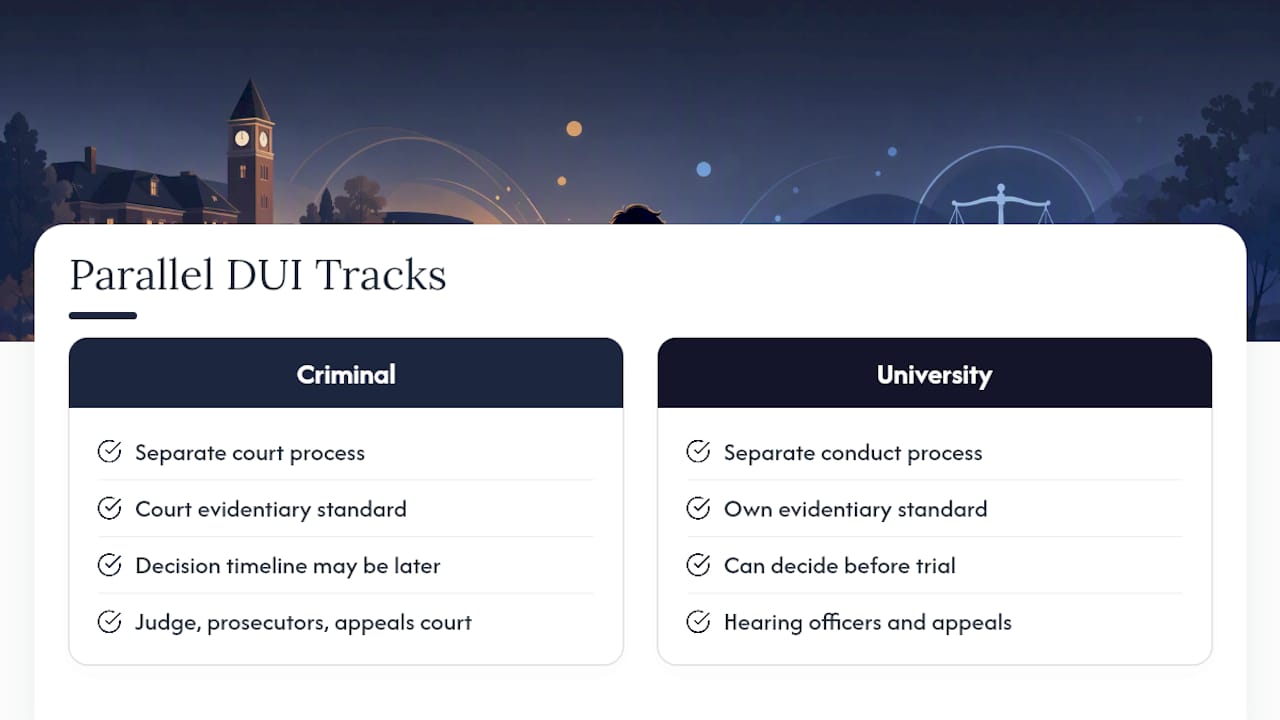
The overlap between a criminal case and a university proceeding is exactly the kind of situation where coordinated legal advice, not guesswork, protects the most ground. Decisions made early in the criminal case, including whether and when to disclose the charge, can ripple into how the university process unfolds.
How Does a DUI Conviction Affect Future Opportunities Like Internships and Jobs?
A conviction follows you well past graduation. Many internship applications and entry-level job postings now include a background check as a standard step, and a DUI conviction typically shows up.
Certain licensing boards ask directly about criminal history, and fields like nursing, education, law, and finance often require disclosure of any conviction, not just felonies. A misdemeanor DUI can trigger extra scrutiny during licensure review even when it doesn’t result in automatic denial.
Employers vary widely in how they treat a DUI on a background check. Some roles involving driving, security clearances, or client-facing trust are more sensitive to it than others. A single conviction rarely ends a career, but it can close doors at the exact moment a student is trying to open them.
Graduate school applications sometimes ask about criminal history too, and an unresolved or poorly handled DUI case can complicate that timing if it’s still pending when applications go out.
This is part of why fighting for a reduced charge, a diversion outcome, or a dismissal isn’t just about avoiding a fine. It’s about keeping the road ahead as open as it was before the arrest.
What Support and Resources Are Available to Students Facing a DUI?
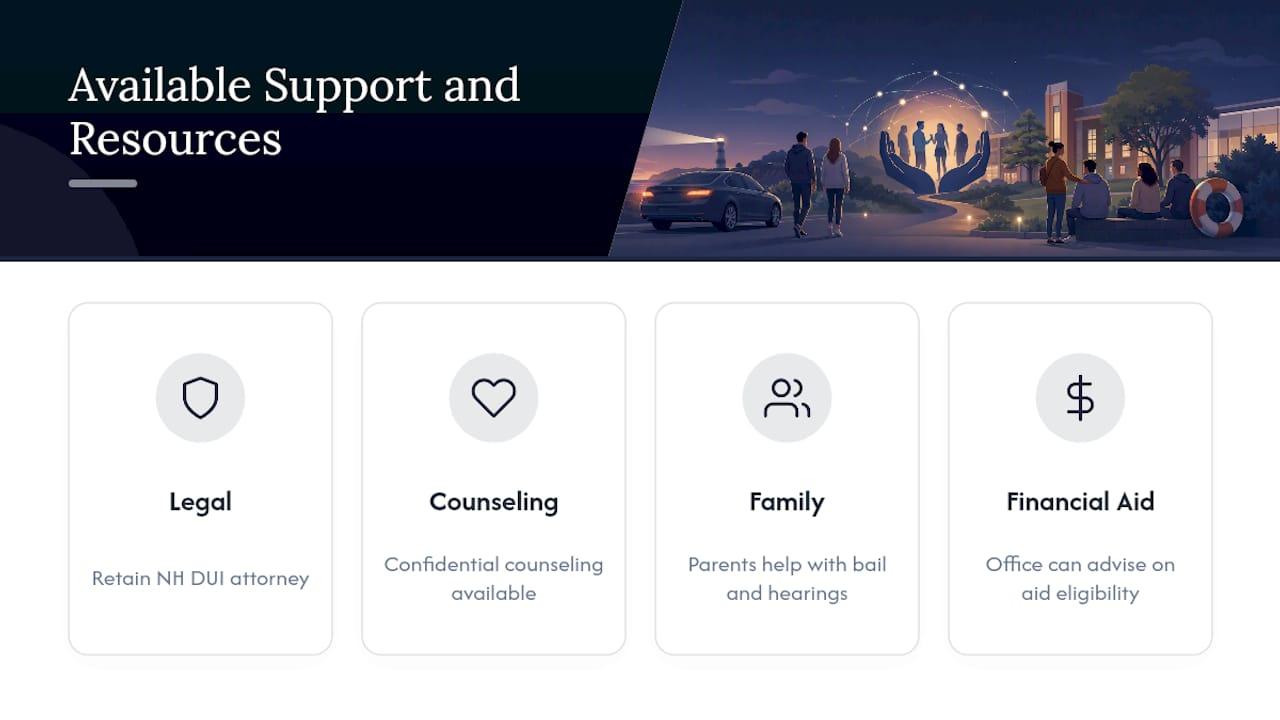
Facing a DUI alone is harder than it needs to be, and support exists on more than one front.
Legal support starts with retaining a qualified NH DUI defense attorney, but many firms also offer guidance on navigating the parallel university process if one exists, since the two tracks can affect each other.
Counseling resources are worth using regardless of how the case turns out. A DUI arrest is stressful, and most universities offer confidential counseling services that have nothing to do with the disciplinary process and everything to do with getting through a hard semester.
Family involvement helps more than students often expect. Parents or guardians can help manage logistics, from bail to attending hearings, freeing the student to focus on classes and the case itself.
Financial aid offices can sometimes advise on how a legal situation might intersect with aid eligibility, and it’s worth a conversation early rather than assuming the worst.
None of these resources replace a defense attorney, but they matter for getting through the process intact, not just legally, but personally.
A Defense Attorney’s Perspective on Defending UNH Students
Thirty-plus years in New Hampshire courtrooms teaches you that the students who come out ahead almost always did one thing right: they got a lawyer involved fast, before evidence went stale and before they said something to police that couldn’t be unsaid. Procedural wins, a bad calibration record, a stop that didn’t hold up, decide more DUI cases than people expect.
What families can do while the defense works: keep the student focused on classes, avoid discussing the case on social media or with classmates, and let the attorney be the only voice speaking for the case publicly. Early representation preserves options that disappear fast otherwise.
— Rich
How Granite Criminal Defense Helps UNH Students Facing DUI Charges
Some law firms bring extensive courtroom experience in New Hampshire, building skills to handle DUI cases by dismantling weak stops, challenging flawed testing, and negotiating effectively. Such experience can be an advantage over trying to handle this alone or waiting to see what happens.
If you’re facing a DUI charge, an important next step is to contact legal counsel before your arraignment, not after, so early motions and evidence requests can be made. Bring your citation, any paperwork from the arrest, and a timeline of what you remember to your first meeting. The firm’s DUI defense page outlines what to expect from representation, and the contact page has direct ways to reach the office today.
Where to Learn More Before Your Court Date
A few resources are worth reading in full before your first court appearance.
- First DUI in New Hampshire: What Happens Next walks through the earliest stages of a case in more depth.
- NH DWI Laws: What Drivers Need to Know breaks down the statutes and penalty ranges behind a New Hampshire DUI charge.
- Why early legal representation changes bail outcomes explains why families arranging release should loop in an attorney immediately, not after the fact.
This article is general information, not a substitute for advice from a qualified lawyer. Consult a qualified legal professional about your own circumstances before acting on anything here.
FAQ
Should a UNH Student Hire a Lawyer for a First DUI?
Yes. A first DUI still carries license suspension, fines, and possible jail time in New Hampshire, and early counsel can preserve evidence and challenge testing before options narrow.
Can a DUI Charge Affect Financial Aid or Scholarships?
It can, depending on the terms of the specific scholarship or aid agreement, since some conduct clauses trigger a review after a charge rather than waiting for a conviction.
Does a DUI Automatically Become a Felony in New Hampshire?
No. Most first DUIs are misdemeanors, but aggravating factors like a high BAC, injury to another person, or prior offenses can push a case toward felony-level exposure.
How Fast Should I Contact an Attorney After a DUI Arrest?
Immediately, ideally before your arraignment, so counsel has time to request discovery, preserve video evidence, and evaluate early motions like suppression.
What Does Granite Criminal Defense Do Differently for DUI Cases?
The firm applies over 30 years of New Hampshire courtroom experience to challenge testing procedures, the legality of the stop, and the strength of the prosecution’s evidence before a case ever reaches trial.
