

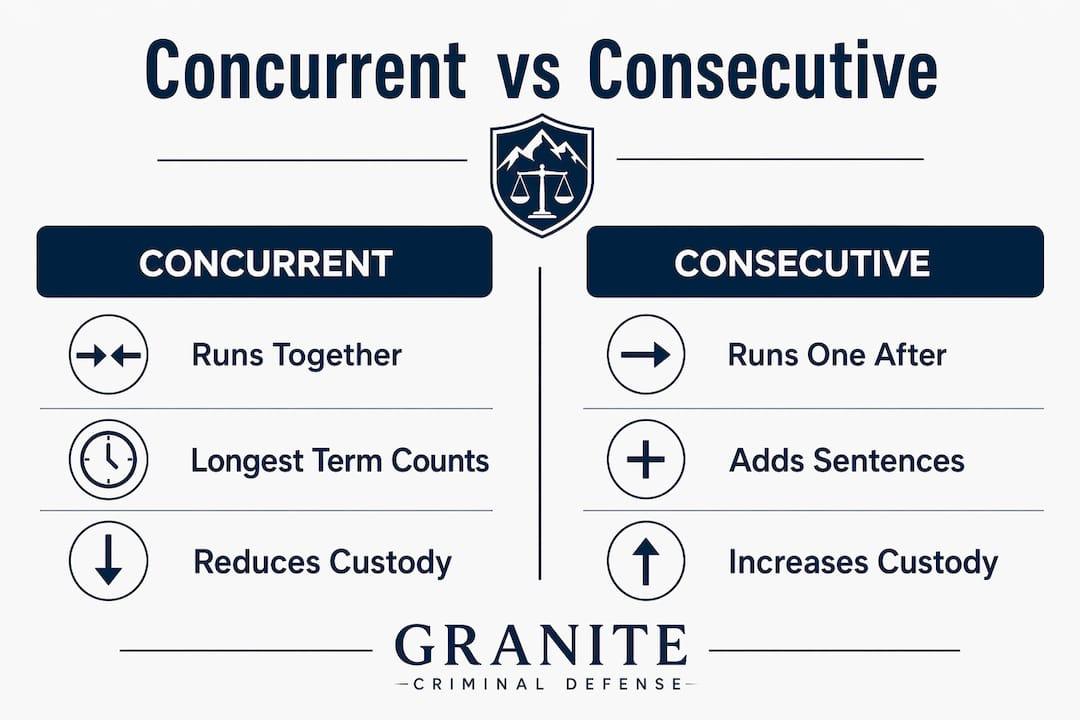
A concurrent sentence runs at the same time as another sentence, so the longest term controls how long you stay in custody. A consecutive sentence runs back-to-back, stacking each term on top of the last. If you’re facing two charges, concurrent is almost always better for you as a defendant. Two five-year sentences served concurrently mean a total term equal to the longest single sentence. Served consecutively, the terms add up to the sum of the sentences. Same convictions, same judge, radically different outcomes.
Table of Contents
- What do concurrent and consecutive sentences actually mean?
- How do judges decide between concurrent and consecutive time?
- How does the sentencing structure affect your actual release date?
- What can your defense attorney do to push for concurrent sentences?
- Can you challenge a judge’s decision to impose consecutive sentences?
- Key Takeaways
- Why early strategy is the difference in sentencing outcomes
- Facing sentencing in New Hampshire? Here’s how Granitecriminaldefense can help
- Useful sources
- FAQ
What do concurrent and consecutive sentences actually mean?
A concurrent sentence allows multiple sentences to run simultaneously. The longest term sets your release date, and the shorter ones finish inside it.
A consecutive sentence runs sequentially. Each term begins only after the previous one ends. The U.S. Courts glossary describes it plainly: two five-year sentences produce five years when concurrent, ten years when consecutive.
How to spot which structure applies to your case:
- Look for the phrase “to run concurrently” or “to run consecutively” in the judgment and commitment order
- If the judgment is silent on multiple counts imposed at the same time, federal law defaults to concurrent under 18 U.S.C. § 3584
- Multiple terms imposed at different times default to consecutive unless the court orders otherwise
- Ask your attorney to pull the Bureau of Prisons sentence computation sheet, which shows how the terms are being aggregated
Think of concurrent sentences as two lanes of traffic moving at the same speed: both reach the finish line together. Consecutive sentences are links in a chain: you can’t reach the second link until you’ve cleared the first.
How do judges decide between concurrent and consecutive time?
Federal judges don’t flip a coin. The decision is governed by statute, guided by sentencing policy, and constrained by the record they build at the hearing.

The controlling federal statutes
18 U.S.C. § 3584(a) sets the default rules: multiple terms imposed at the same time run concurrently unless the court orders or a statute mandates otherwise. When deciding which way to go, § 3584(b) requires the court to consider the factors in 18 U.S.C. § 3553(a), including the seriousness of the offense, the need for deterrence, protection of the public, and the history and characteristics of the defendant.
USSC §5G1.2 adds a practical framework: the court determines a “total punishment” and then allocates it across counts. If the highest-maximum count can carry the full total punishment, all other counts should run concurrently. Consecutive terms are only added to the extent necessary to reach the total punishment the guidelines call for.
Mandatory consecutive sentences
Some statutes strip the judge of discretion entirely. A conviction under 18 U.S.C. § 924© for using a firearm during a drug trafficking crime or crime of violence carries a mandatory minimum that must run consecutively to any other term. There is no negotiating around it at sentencing.
Federal vs. state rules
| Factor | Federal (18 U.S.C. § 3584) | State example (NY Penal Law § 70.25) |
|---|---|---|
| Who decides | Judge, guided by § 3553(a) and USSC §5G1.2 | Judge, guided by state statute and case law |
| Default when silent | Concurrent (same-time imposition) | Varies; NY generally allows concurrent for most felonies |
| Mandatory consecutive | Yes — e.g., § 924© firearm counts | Yes — NY has mandatory consecutive rules for certain violent felonies |
| Discretionary factors | Seriousness, deterrence, criminal history, victim impact | Similar factors; state guidelines may differ significantly |
| Appellate standard | Abuse of discretion / substantive reasonableness | Varies by state; often abuse of discretion |
NY Penal Law § 70.25 is a useful illustration of how state rules can diverge from federal practice. New Hampshire has its own sentencing statutes, and the rules governing whether terms run concurrently or consecutively in state court here are not identical to the federal framework. If you’re in a New Hampshire state court, the specific statute and charge matter enormously.
How does the sentencing structure affect your actual release date?
The math is straightforward once you know the structure. The real-world complications come from good-time credits, parole eligibility, and how the Bureau of Prisons or a state corrections department aggregates the terms.
Calculating total custody time
Under 18 U.S.C. § 3584©, multiple terms ordered to run consecutively or concurrently are treated as a single aggregate term for administrative purposes. That aggregate is what the BOP uses to calculate your projected release date.
| Sentence structure | Count 1 | Count 2 | Total custody |
|---|---|---|---|
| Concurrent | Term 1 | Term 2 | Equal to the longest single term |
| Consecutive | Term 1 | Term 2 | Sum of the individual terms |
| Partially concurrent | Term 1 | Term 2 (partially overlapping) | Somewhere between the longest term and the sum of the terms |
Supervised release runs separately. Even if your prison terms run concurrently, each count may carry its own supervised release tail, and courts sometimes order those to run consecutively. A defendant who serves five concurrent years could still face staggered supervised release terms that extend post-custody supervision well beyond what the prison math suggests.
Good-time credit under federal law can reduce a sentence by up to 54 days per year of sentence imposed, which meaningfully shortens the actual time served on longer terms. State good-time rules vary widely. New Hampshire’s rules differ from federal practice, and parole eligibility in state cases adds another variable entirely.
Pro Tip: Never rely on a rough calculation you run yourself. Ask your attorney to request a formal sentence computation projection from the BOP or the relevant state corrections department before you accept a plea. The difference between concurrent and consecutive supervised release tails can add years to your supervision.
What can your defense attorney do to push for concurrent sentences?
The window for securing concurrent time opens early and closes fast. By the time you’re standing at the sentencing podium, most of the leverage has already been used or lost.
Steps a skilled defense attorney takes:
- Grouping analysis under USSC §5G1.2: If counts are closely related or groupable under §3D1.2, the guidelines favor concurrent treatment. Counsel should document this argument in writing before sentencing.
- Sentencing memorandum: A well-crafted memo addresses every § 3553(a) factor, presents mitigation evidence (employment history, family ties, mental health, substance abuse treatment), and argues that the total punishment can be achieved through the longest single count running concurrently with the others.
- Letters of support: Character letters from family, employers, clergy, and treatment providers give the judge a human picture that bare case facts don’t provide.
- Plea agreement language: The most reliable path to concurrent sentences is locking them in through the plea agreement itself. Sample clause: “The parties agree to jointly recommend that all counts of conviction run concurrently with one another.” That language, once accepted by the court, is far harder to walk back than a bare request at sentencing.
- Allocution: The defendant’s own statement at sentencing, prepared carefully with counsel, can reinforce the mitigation narrative and directly address the § 3553(a) factors the judge is weighing.
Counsel should also check for statutory bars to consecutive sentencing. Under § 3584(a), terms may not run consecutively for an attempt and for the offense that was the sole objective of that attempt. That bar is a concrete leverage point in plea negotiations when the charge set includes both an attempt count and the completed offense.
The criminal defense process moves through plea, sentencing, and appeal in a sequence where each stage shapes the next. Missing the grouping argument at plea can cost a defendant years.
Can you challenge a judge’s decision to impose consecutive sentences?
Yes, but the standard is demanding and the record you build at sentencing is everything.
Appellate courts review consecutive sentencing decisions for abuse of discretion, asking whether the sentence was “arbitrary, capricious, whimsical, or manifestly unreasonable.” That’s a high bar. In United States v. Jones (10th Cir. 2017), the court affirmed an 18-month consecutive sentence where the district court had expressly addressed the § 3553(a) factors and explained why concurrent treatment would have no deterrent effect given that the firearm offense was unrelated to the underlying charges.
Common grounds for challenge:
- The court failed to consider or adequately weigh the § 3553(a) factors on the record
- The consecutive structure results in double-counting an enhancement already reflected in the guideline range
- A statutory bar applies (e.g., attempt plus completed offense)
- The court misapplied USSC §5G1.2 in calculating total punishment
Procedurally, you must object at sentencing. A specific, on-the-record objection to the consecutive structure preserves the issue for appeal. A general objection to the sentence length is not enough. After sentencing, post-sentence motions can address clerical errors or newly discovered statutory bars, but they rarely undo a discretionary consecutive decision.
Pro Tip: If your attorney believes the consecutive structure was legally improper, the objection must be stated specifically at the sentencing hearing, on the record, before the judge leaves the bench. Waiting until appeal to raise it for the first time almost always results in plain-error review, which is nearly impossible to win.
Key Takeaways
Concurrent sentences reduce total custody time by running simultaneously; consecutive sentences stack terms and can multiply time served dramatically.
| Point | Details |
|---|---|
| Default federal rule | Under 18 U.S.C. § 3584(a), same-time sentences run concurrently unless the court or a statute orders otherwise. |
| Mandatory exceptions | Statutes like 18 U.S.C. § 924© require consecutive terms regardless of what the judge or parties prefer. |
| Guideline framework | USSC §5G1.2 directs courts to set a total punishment and run other counts concurrently if the highest-maximum count covers it. |
| Preserve your objection | A specific on-the-record objection at sentencing is required to preserve a consecutive-sentence challenge for appeal. |
| Get local counsel | Granitecriminaldefense handles sentencing strategy, plea negotiations, and concurrent-sentence arguments for New Hampshire defendants. |
Why early strategy is the difference in sentencing outcomes
The cases where concurrent sentences are hardest to win are the ones where defense counsel arrived late to the grouping argument. By the time a sentencing date is set, the plea agreement is already signed, and whatever concurrent-sentence language it contains, or doesn’t contain, is locked in. The mitigation that moves judges, the letters, the treatment records, the employment documentation, takes months to assemble properly. Rushing it produces thin filings that judges can dismiss in a paragraph.
What actually works is building the concurrent-sentence argument from the first client meeting. That means identifying which counts are groupable under §3D1.2, flagging any statutory bars to consecutive treatment, and drafting plea language that locks in concurrent recommendations before the government has any reason to push back. At sentencing, the memorandum should walk the court through every § 3553(a) factor with specificity, not generalities. Judges who impose consecutive sentences almost always do so because the record supports it. The job is to build a record that doesn’t.
For domestic violence cases, where multiple related counts are common and consecutive sentences are a real risk, mitigation strategy should be part of the defense plan from day one, not an afterthought at sentencing.
Facing sentencing in New Hampshire? Here’s how Granitecriminaldefense can help
Thirty-plus years of New Hampshire courtroom experience means Granitecriminaldefense has argued concurrent-sentence requests across the full range of criminal charges, from DUI and misdemeanor cases to serious felony defense matters where the difference between concurrent and consecutive time is measured in years of a client’s life. The firm prepares full sentencing mitigation packages, including grouping analyses, § 3553(a) memoranda, and character evidence, and negotiates plea language specifically designed to lock in concurrent recommendations before sentencing. For defendants already past the plea stage, the firm handles sentencing hearings and, where the record supports it, appeals of consecutive sentencing decisions. If you’re facing multiple counts in New Hampshire and want to understand what your actual projected release date looks like under different sentencing structures, contact Granitecriminaldefense to schedule a consultation.
Useful sources
The statutes and guidelines below are the primary authorities on concurrent and consecutive sentencing. Pull the exact text before any sentencing hearing.
| Resource | What it covers |
|---|---|
| 18 U.S.C. § 3584 | Federal default rules for concurrent and consecutive terms; aggregate treatment |
| 18 U.S.C. § 3553(a) | Sentencing factors courts must weigh when choosing concurrent or consecutive structure |
| USSC §5G1.2 | Guideline framework for total punishment and allocation across multiple counts |
| NY Penal Law § 70.25 | Illustrative state statute showing how state rules can differ from federal practice |
| Granitecriminaldefense.com | New Hampshire criminal defense; consult for state-specific sentencing projections |
State codes vary significantly. For New Hampshire-specific rules, verify current statutes with counsel rather than relying on federal or out-of-state examples.
FAQ
Do concurrent sentences run at the same time?
Yes. A concurrent sentence runs simultaneously with other sentences, so the longest term determines when custody ends.
Is a concurrent or consecutive sentence better for a defendant?
Concurrent is almost always better because it limits total custody time to the longest single term rather than adding each sentence on top of the last.
When are consecutive sentences mandatory under federal law?
Certain statutes, most notably 18 U.S.C. § 924© for firearm offenses during drug trafficking or violent crimes, require the sentence to run consecutively regardless of judicial discretion.
What is the Romeo and Juliet law in New Hampshire?
New Hampshire’s age-gap provision reduces criminal liability for certain consensual sexual conduct between minors close in age; it is a separate statutory framework unrelated to concurrent or consecutive sentencing structure.
How does good-time credit interact with concurrent sentences?
Good-time credit reduces the time actually served within the aggregate term, but it does not change whether sentences run concurrently or consecutively. Ask counsel for a formal sentence computation that applies the applicable good-time rate to your specific aggregate term.
This article is general legal information, not legal advice for your specific situation. Sentencing rules vary by jurisdiction and charge. Consult a qualified criminal defense attorney to understand how these rules apply to your case.
