

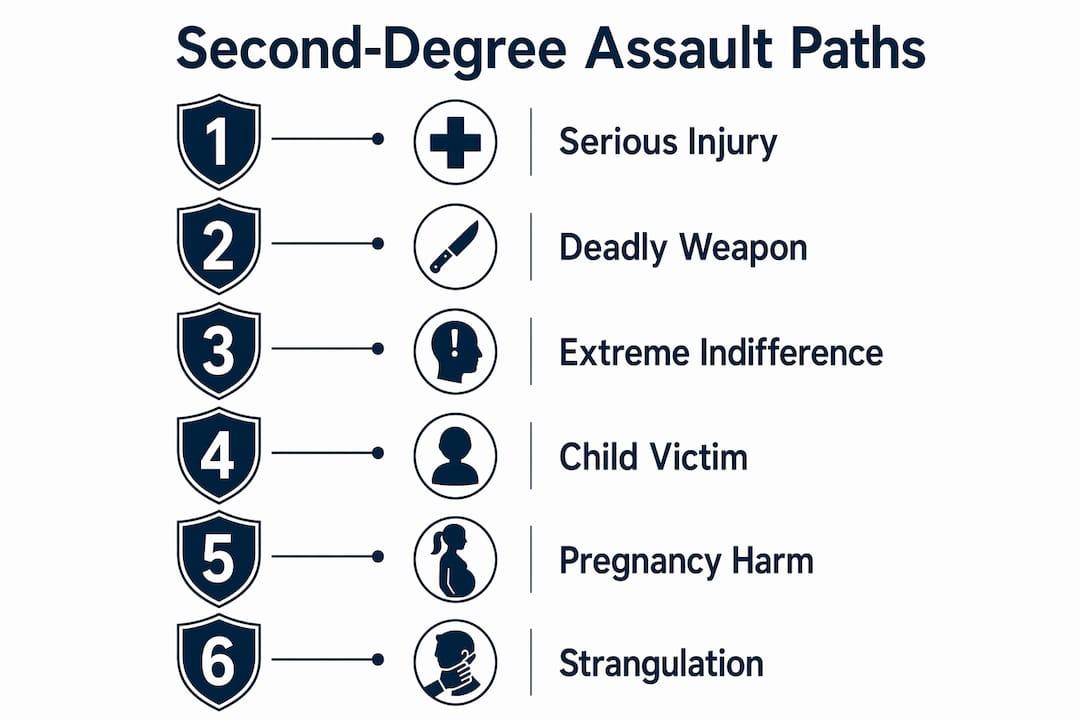
Second-degree assault in New Hampshire is a Class B felony under RSA 631:2, and a conviction can mean up to seven years in state prison. The statute lists multiple categories of conduct that trigger the charge:
- Knowingly or recklessly causing serious bodily injury to another person
- Recklessly causing bodily injury using a deadly weapon (with a firearm sentencing carve-out under RSA 651:2 II-g)
- Reckless conduct showing extreme indifference to human life that causes bodily injury
- Purposely or knowingly causing bodily injury to a child under 13
- Recklessly or negligently causing injury that results in miscarriage or stillbirth
- Purposely or knowingly strangling another person
If you have been charged, preserve any evidence, write down witness contact information, and call a criminal defense attorney before making any statement to police.
Pro Tip: Do not assume a charge will “sort itself out.” A Class B felony in New Hampshire follows you permanently unless addressed aggressively from day one.
Table of Contents
- What does second-degree assault in NH actually cover under RSA 631:2?
- How does the statute define miscarriage, stillbirth, and strangulation?
- What are the penalties for a second-degree assault conviction in NH?
- What happens when the charge is recorded as domestic violence?
- How does second-degree assault differ from first-degree assault in New Hampshire?
- What should you do immediately after an arrest for second-degree assault?
- What are the collateral consequences of a Class B felony conviction?
- Key Takeaways
- Why the first call you make after an assault charge matters most
- Facing a second-degree assault charge in New Hampshire?
- Useful sources
- FAQ
What does second-degree assault in NH actually cover under RSA 631:2?
RSA 631:2 is the controlling statute, and each of its six subsections describes a different path to a second-degree assault charge. Understanding which one applies to your situation shapes every defense decision.
I(a): Serious bodily injury, knowingly or recklessly
This is the most commonly charged subsection. The prosecution must prove the defendant either knew their conduct would cause serious bodily injury or consciously disregarded a substantial risk of it. A broken jaw from a single punch, a fractured orbital bone, or a spinal injury from a shove down stairs can all qualify. “Serious bodily injury” is a higher bar than ordinary injury; it typically involves a substantial risk of death, permanent disfigurement, or protracted loss of a body part or organ.

I(b): Bodily injury with a deadly weapon, recklessly
Here the injury threshold drops to ordinary bodily injury, but the weapon elevates the charge. A knife, a bat, or a vehicle can qualify as a deadly weapon. When the weapon is a firearm, sentencing is governed by the cross-reference to RSA 651:2 II-g, which can significantly increase the penalty beyond the standard Class B felony range.
I©: Extreme indifference to human life
This subsection targets reckless conduct so dangerous it demonstrates a disregard for whether someone lives or dies. Think of someone firing a gun into a crowd or driving at high speed through a pedestrian area. No specific victim needs to be targeted; the recklessness itself, directed at human life generally, is enough.
I(d): Bodily injury to a child under 13
The mental state required here is purpose or knowledge, and the victim’s age is the aggravating factor. Any intentional act causing bodily injury to a child under 13 meets this element, regardless of whether the injury would be considered “serious” under subsection (a).
I(e): Miscarriage or stillbirth caused by injury
This subsection covers situations where reckless or negligent conduct causes injury to a pregnant person and that injury results in a miscarriage or stillbirth. The causal chain between the defendant’s act and the pregnancy loss is central to prosecution.
I(f): Strangulation
Purposely or knowingly impeding another person’s breathing or blood circulation by applying pressure to the throat or neck, or by blocking the nose or mouth, constitutes strangulation under the statute. This subsection has become a significant charging tool in domestic-violence cases, where strangulation is a recognized escalation indicator.
How does the statute define miscarriage, stillbirth, and strangulation?
RSA 631:2 II supplies definitions for three terms that appear in the subsections above. Courts apply these definitions precisely, so understanding them matters.
- Miscarriage is defined as the interruption of the normal development of a fetus other than by a live birth or a medically induced termination. The statute deliberately excludes induced abortion from this definition, limiting its reach to unintended pregnancy loss caused by an external act.
- Stillbirth means the death of a fetus that has reached a gestational stage where it would otherwise be viable outside the womb. The distinction from miscarriage generally turns on gestational age and viability.
- Strangulation is defined as intentionally impeding the normal breathing or circulation of blood by applying pressure to the throat or neck, or by blocking the nose or mouth. The statute specifically notes observable signs: impeded breathing, change in voice, petechial hemorrhaging, and similar physical indicators.
These definitions matter at trial because the prosecution must prove each element using the statute’s own language. A defense that challenges whether the evidence actually meets the statutory definition of strangulation, for example, can be the difference between a felony conviction and a lesser charge or acquittal.
What are the penalties for a second-degree assault conviction in NH?
A Class B felony conviction in New Hampshire carries a maximum prison sentence of seven years. Fines, restitution, and probation are also on the table, and the court has broad discretion in structuring a sentence within those limits.
| Offense type | Max prison (typical) | Notes |
|---|---|---|
| Second-degree assault (standard) | seven years | Class B felony; RSA 631:2 |
| Second-degree assault with a firearm | Increased beyond seven years | RSA 651:2 II-g firearm cross-reference applies |
| Second-degree assault recorded as domestic violence | seven years + additional $50 fine | RSA 631:2 III domestic-violence recording |
The firearm sentencing cross-reference under RSA 651:2 II-g is not a minor detail. When a firearm is involved, the sentencing framework shifts, and the maximum exposure increases substantially beyond the standard Class B felony ceiling.
Beyond prison time, a conviction typically triggers mandatory restitution to the victim, probation supervision, court-ordered assessments, and, in domestic-violence cases, a mandatory $50 fine under RSA 631:2 III. Judges also routinely impose conditions of release or probation that restrict contact with the victim and require completion of intervention programs.
What happens when the charge is recorded as domestic violence?
RSA 631:2 III requires that when the victim and defendant are intimate partners or household members, the conviction be recorded as “second degree assault-domestic violence.” This is not a separate crime; it is a designation that attaches to the same Class B felony conviction and carries specific statutory consequences.
The statute mandates an additional $50 fine on top of any other penalty. That fine cannot be reduced or waived, and the funds are forwarded to the New Hampshire Department of Health and Human Services. The domestic-violence label also appears on the public criminal record, which has real downstream effects: it can trigger federal firearms prohibitions under the Lautenberg Amendment, complicate custody and parenting-rights proceedings, and make it significantly harder to have the record annulled later. Restraining orders often accompany domestic-violence assault charges, and violating those orders creates a separate criminal exposure. If you are facing a charge with a domestic-violence designation, the domestic violence defense implications deserve immediate attention alongside the assault charge itself.
How does second-degree assault differ from first-degree assault in New Hampshire?
First-degree assault under RSA 631:1 is a Class A felony, and second-degree assault under RSA 631:2 is a Class B felony. The key distinctions are the severity of injury, required mental state, and circumstances such as weapon use, victim’s age, and special categories like strangulation or causing miscarriage/stillbirth. Class A felonies carry up to fifteen years in prison in New Hampshire, while Class B felonies carry a maximum of seven years.
What should you do immediately after an arrest for second-degree assault?
The first 48 hours after an arrest matter more than most people realize. Here is what to prioritize:
- Say nothing to police without counsel present. Anything you say will be used against you. Invoke your right to an attorney clearly and immediately.
- Preserve all digital evidence. Text messages, call logs, social media posts, and location data can disappear quickly. Screenshot and back up everything relevant before it is deleted or overwritten.
- Request medical records immediately. If you or the alleged victim received medical treatment, those records are central to the case. Get them before they become harder to access.
- Write down everything you remember. Witness names, contact information, the sequence of events, and any context that explains what happened. Memory fades fast.
- Identify surveillance footage. Businesses, residences, and traffic cameras often overwrite footage within days. Your attorney needs to request preservation immediately.
- Retain a felony defense attorney before your arraignment. The arraignment is not a formality; bail conditions set there can affect your life for months.
Common defense approaches in second-degree assault cases include challenging the mental-state element (was the conduct truly “reckless” or “knowing”?), asserting self-defense or defense of others, contesting whether the injury meets the statutory definition of “serious bodily injury,” and attacking causation when the prosecution’s theory relies on a chain of events rather than a direct act. Mistaken identity and insufficient witness credibility are also viable angles depending on the facts.
Pro Tip: Challenging “serious bodily injury” often requires both the victim’s medical records and an independent medical expert who can contest the severity or causation the prosecution claims. Retain counsel early enough to commission that review before trial.
Granitecriminaldefense conducts independent investigations as a standard part of felony defense, not an add-on. Early investigation, before witnesses’ memories fade and before digital evidence is lost, consistently changes the direction of assault cases.
What are the collateral consequences of a Class B felony conviction?
A prison sentence is the headline, but the collateral consequences of a felony conviction in New Hampshire reach further and last longer than most people expect.
Firearm rights are lost under both federal and state law upon a felony conviction. For many clients, this is permanent and cannot be restored through the criminal process alone.
Professional licensing is at risk across a wide range of fields. Nursing, teaching, law, real estate, and dozens of other licensed professions require applicants to disclose felony convictions, and licensing boards have broad discretion to deny or revoke licenses.
Employment and housing barriers are real and immediate. Background checks are standard, and a felony record narrows options significantly in both the job market and rental housing.
Immigration consequences can be severe for non-citizens. A felony assault conviction may constitute a crime of violence under federal immigration law, triggering deportation proceedings or bars to naturalization. Immigration consequences require specialized immigration counsel, not just criminal defense counsel.
Voting and jury service rights are affected during any period of incarceration and, in some cases, beyond.
Record annulment exists in New Hampshire under limited circumstances and can help with some of these consequences, but it is not automatic and not available to everyone. The criminal record annulment process has specific eligibility requirements that depend on the offense, the sentence, and the time elapsed since conviction.
Key Takeaways
Second-degree assault in New Hampshire is a Class B felony under RSA 631:2, carrying up to seven years in prison, and the charge can be triggered by six distinct categories of conduct ranging from strangulation to causing a miscarriage.
| Point | Details |
|---|---|
| Felony classification | Second-degree assault is a Class B felony under RSA 631:2, with a maximum of seven years in prison. |
| Six statutory triggers | Conduct ranges from serious bodily injury to strangulation, child injury, and causing miscarriage or stillbirth. |
| Firearm sentencing increase | RSA 651:2 II-g applies when a firearm is involved, pushing the maximum penalty above the standard Class B ceiling. |
| Domestic-violence recording | When parties are intimate partners or household members, the conviction carries a mandatory additional $50 fine and a domestic-violence label. |
| Granitecriminaldefense | With over 30 years of courtroom experience, Granitecriminaldefense handles felony assault defense in New Hampshire, including independent investigation and tailored strategy. |
Why the first call you make after an assault charge matters most
Most people charged with second-degree assault in New Hampshire make the same mistake: they wait. They assume the charge is an overreach, that the facts will speak for themselves, or that cooperating with police will help. None of those assumptions hold up in a felony prosecution.
What actually changes outcomes is what happens in the first days after an arrest. Surveillance footage gets overwritten. Witnesses talk to each other and align their stories. Medical records get interpreted by prosecution experts before the defense has a chance to challenge them. The window for independent investigation is narrow, and once it closes, it does not reopen.
The conventional wisdom that “a good lawyer can fix it later” misunderstands how felony cases are built. Prosecutors build their case from the moment of arrest. A defense that starts at arraignment is already behind. The firms that get the best results in assault cases are the ones that treat day one as the most important day, not the trial date.
There is also a tendency to underestimate what a Class B felony conviction actually costs. Seven years is the headline, but the firearm prohibition, the licensing consequences, the immigration exposure, and the permanent public record are what reshape a life. The charge deserves the same urgency as the sentence it can produce.
Facing a second-degree assault charge in New Hampshire?
Granitecriminaldefense brings over 30 years of courtroom experience to felony assault defense in New Hampshire, with bilingual English/Spanish representation and a practice built on independent investigation rather than plea-first strategy. When you are charged with a Class B felony, the difference between a conviction and a dismissal often comes down to how fast your defense team moves and how thoroughly they examine the evidence the prosecution is relying on.
The firm handles the full range of felony defense in New Hampshire, from evidence analysis and independent witness interviews to challenging the prosecution’s theory at trial. If your charge carries a domestic-violence designation, the firm’s practice covers that dimension as well. Contact Granitecriminaldefense to schedule a consultation and get a direct assessment of your case before your next court date.
Useful sources
- RSA 631:2 Second Degree Assault (NH Government): The official statutory text from gc.nh.gov, including all six subsections and the statutory definitions of miscarriage, stillbirth, and strangulation. This is the primary source for any question about what the law actually says.
- RSA 631:2 on Justia: A mirrored version of the statute with the universal citation (NH Rev Stat § 631:2). Useful for cross-referencing language and for readers who want a secondary formatted version of the text.
- New Hampshire Assault Laws (CriminalDefenseLawyer.com): A plain-English overview of assault penalties in New Hampshire, including the Class B felony classification and the firearm sentencing cross-reference. Helpful for understanding how the statute translates into real sentencing outcomes.
- RSA 631:2 with Domestic-Violence Provisions (WomensLaw.org): Includes the full statutory text of RSA 631:2 III, covering the domestic-violence recording requirement and the mandatory $50 fine language.
FAQ
Is second-degree assault a felony in NH?
Yes. Second-degree assault is a Class B felony under RSA 631:2, carrying a maximum of seven years in prison.
How serious is a second-degree assault charge?
It is one of the more serious charges in New Hampshire’s criminal code. Beyond prison time, a conviction can cost you firearm rights, professional licenses, and, for non-citizens, immigration status.
What counts as assault under New Hampshire law?
New Hampshire assault charges range from simple assault (a misdemeanor) through second-degree assault (Class B felony) to first-degree assault (Class A felony), depending on the severity of injury, the mental state, and the circumstances such as weapon use or the victim’s age.
How long can you go to jail for first-degree assault in NH?
First-degree assault under RSA 631:1 is a Class A felony, which carries a higher maximum sentence than the seven-year ceiling for second-degree assault. Class A felonies in New Hampshire can result in sentences up to fifteen years.
Can a second-degree assault charge be defended successfully?
Yes, and the most effective defenses typically challenge the mental-state element, contest whether the injury meets the statutory definition, or assert self-defense. Early evidence preservation and independent investigation, the approach Granitecriminaldefense uses, significantly improve the odds of a favorable outcome.
This article provides general legal information about New Hampshire law and is not legal advice. Laws can change, and the application of any statute depends on the specific facts of your case. Consult a qualified New Hampshire criminal defense attorney for guidance on your situation.
