
A first-time DWI in New Hampshire is almost always charged as a Class B misdemeanor, carrying a fine that starts at $500 and often lands between $1,020 and $2,000 once assessments are added. Plus, a license revocation typically lasts several months to about a year. You’ll also face a mandatory referral to the Impaired Driver Care Management Program, and the administrative suspension of your license can start before your court date even happens. A law firm with experience in New Hampshire handles exactly this kind of case in the state.
TL;DR:
- A first-time DWI in New Hampshire usually results in a fine between $500 and $2,000, with license revocation lasting several months to a year.
- Administrative license suspension begins immediately after arrest if a BAC of 0.08 or higher (or 0.02 for under 21) is recorded, with a 30-day window to request a hearing.
- Mandatory IDCMP screening and treatment can suspend the license revocation for up to six months if completed on time, but delays risk reinstating the full revocation period.
- Aggravated DWI factors, such as a BAC of 0.16 or higher or causing injury, significantly increase fines, revocation length, and jail risk, especially for drivers under 21.
- Costs beyond fines, including court fees, insurance premium increases, and potential legal expenses, often make the total financial impact several times higher than the initial penalty.
Table of Contents
- What Are the Statutory Penalties for a First-Offense DWI in New Hampshire?
- What Happens With My License Right After Arrest?
- How Does Court Sentencing and IDCMP Work for a First DWI?
- What Makes a DWI Aggravated, and How Does Age Change the Rules?
- What Should I Do in the First Days After a DWI Arrest?
- How Granite Criminal Defense Approaches a First-Offense DWI
- What Does a First DWI Actually Cost Beyond the Fine?
- What Are the Steps From Arrest to Case Resolution in New Hampshire?
- Can a First DWI Be Reduced or Dismissed Through a Plea?
- What a Reasonable Outcome Often Looks Like in NH Courts
- Get Help With Your First DWI Case Today
- Sources
- FAQ
What Are the Statutory Penalties for a First-Offense DWI in New Hampshire?
Under RSA 265-A:18, a first-time DWI conviction under RSA 265-A:2 is classified as a Class B misdemeanor. That classification matters because it caps your exposure lower than a Class A misdemeanor, but it still leaves real consequences on the table.
The statute sets a fine floor of $500, and state transportation officials report that in practice, total fines and penalty assessments for a first offense commonly run between $500 and $2,000, depending on the specific circumstances and court fees layered on top. Jail time is possible, up to 6 months in some cases, though it is far less common for a compliant first-time offender than fines and license consequences.
A judge has considerable latitude in how these pieces get assembled into an actual sentence. Two people with nearly identical BAC results can walk out of court with different outcomes based on:
- Whether they cooperated during the stop and testing
- Driving conduct, like whether there was an accident or high-speed pursuit
- Their compliance with the required IDCMP screening
- Whether the court finds any aggravating circumstances
Quick reference: A first-offense Class B misdemeanor DWI carries a minimum fine of $500 under RSA 265-A:18, with total costs frequently reaching $2,000 once assessments and fees are included.
What Happens With My License Right After Arrest?
Administrative License Suspension (ALS) is a separate track from your criminal case, and it moves fast. The moment you’re arrested for DWI and a test shows a BAC of 0.08 or higher (0.02 for drivers under 21), the arresting officer can issue a notice that starts your suspension clock, according to RSA 265-A:30.
For a first-time offender who submits to testing, that suspension typically runs several months. Refuse the test, and you face an automatic suspension lasting about six months regardless of what your BAC eventually shows. The suspension itself doesn’t take effect immediately; state administrative rules give it a 30-day window after the notice is served, during which you may receive a temporary permit to keep driving.
Here’s how to use that window:
- Read the notice carefully for the exact date the suspension becomes effective.
- Request an ALS hearing within the timeframe stated on the notice. Missing this step forfeits your right to challenge it.
- Gather any records from the stop, arrest, and testing before memories fade or footage gets purged.
Pro Tip: File your ALS hearing request the same day you’re arraigned, if possible. The 30-day window moves faster than most people expect, and a missed deadline locks in the suspension automatically.
How Does Court Sentencing and IDCMP Work for a First DWI?
Every first-time DWI conviction in New Hampshire triggers a mandatory referral to the Impaired Driver Care Management Program. This isn’t optional paperwork. The IDCMP screening determines whether you need further evaluation and what treatment, if any, a court will order as part of your sentence.
Compliance carries real weight. Under RSA 265-A:18, a court may suspend up to six months of your license revocation if you complete IDCMP screening and treatment on the court’s timeline. Miss those deadlines, and that suspended time comes back.
Judges document all of this on the DWI Sentencing Order form (NHJB-2094-D), which lists:
- Fine amount and payment schedule
- License revocation length and any suspended portion
- IDCMP screening and treatment deadlines
- Ignition interlock requirements, if ordered
- Additional conditions like a victim impact panel or random testing
Interlock isn’t automatic for a first, non-aggravated offense, but when a court does order one under RSA 265-A:36, the minimum term runs 12 months, and you pay for installation and monitoring out of pocket. Courts also retain discretion to reduce a DWI conviction to a violation-level offense on motion, usually reserved for cases with strong mitigating facts and full compliance.
What Makes a DWI Aggravated, and How Does Age Change the Rules?
Certain facts push a first offense into aggravated territory, which raises the stakes considerably. Courts and prosecutors typically look at:
- A BAC of 0.16 or higher
- Driving 30 mph or more over the speed limit
- Attempting to elude an officer
- Causing a collision, especially one involving injury
- Having a passenger under age 16 in the vehicle
- A prior DWI conviction, including one from out of state, treated as a prior in New Hampshire
Aggravated DWI carries harsher fines, longer revocation, and a much higher chance of jail time. If any of these facts apply to your case, the analysis changes significantly. Our breakdown of aggravated DWI in New Hampshire covers how that charge differs from a standard first offense.
Drivers under 21 face a stricter standard across the board. The BAC threshold drops to 0.02, and a conviction triggers a mandatory one-year license revocation with no discretion for the court to shorten it.
What Should I Do in the First Days After a DWI Arrest?
The choices you make in the first 30 days shape both your ALS hearing and your criminal case. Here’s a practical order of operations:
- Request your ALS hearing immediately. This is time-sensitive and it’s the one deadline you cannot afford to miss.
- Write down everything you remember about the stop: what the officer said, what tests you were asked to perform, and how long you were detained.
- Photograph the scene if you’re able, including road conditions, signage, and where your vehicle was parked or stopped.
- Get names and contact information for any witnesses, including passengers.
- Contact an attorney before your arraignment, not after.
That last step matters more than people assume. Common defense angles in a first-offense DWI case include challenging the officer’s probable cause for the stop, questioning the calibration and maintenance records of the breath-testing device, and scrutinizing chain-of-custody on blood samples. None of that groundwork happens on its own, and evidence like maintenance logs and dispatch recordings can be harder to obtain the longer you wait. For a fuller timeline of what to expect, see what happens after a first DUI in New Hampshire.
Pro Tip: Ask your attorney to request calibration and maintenance logs for the breath-testing device used in your stop as early as possible. These records sometimes reveal gaps that never make it into the police report.
How Granite Criminal Defense Approaches a First-Offense DWI
Some law firms build first-offense DWI cases around evidence review, independent investigation, and ALS hearing representation. That means checking testing equipment records, interviewing witnesses, and challenging weak points in the state’s case before they harden into a conviction.
The firm also helps clients navigate IDCMP screening deadlines, coordinate ignition interlock requirements when ordered, and, where the facts support it, pursue motions to reduce a conviction to a lesser violation.
What Does a First DWI Actually Cost Beyond the Fine?
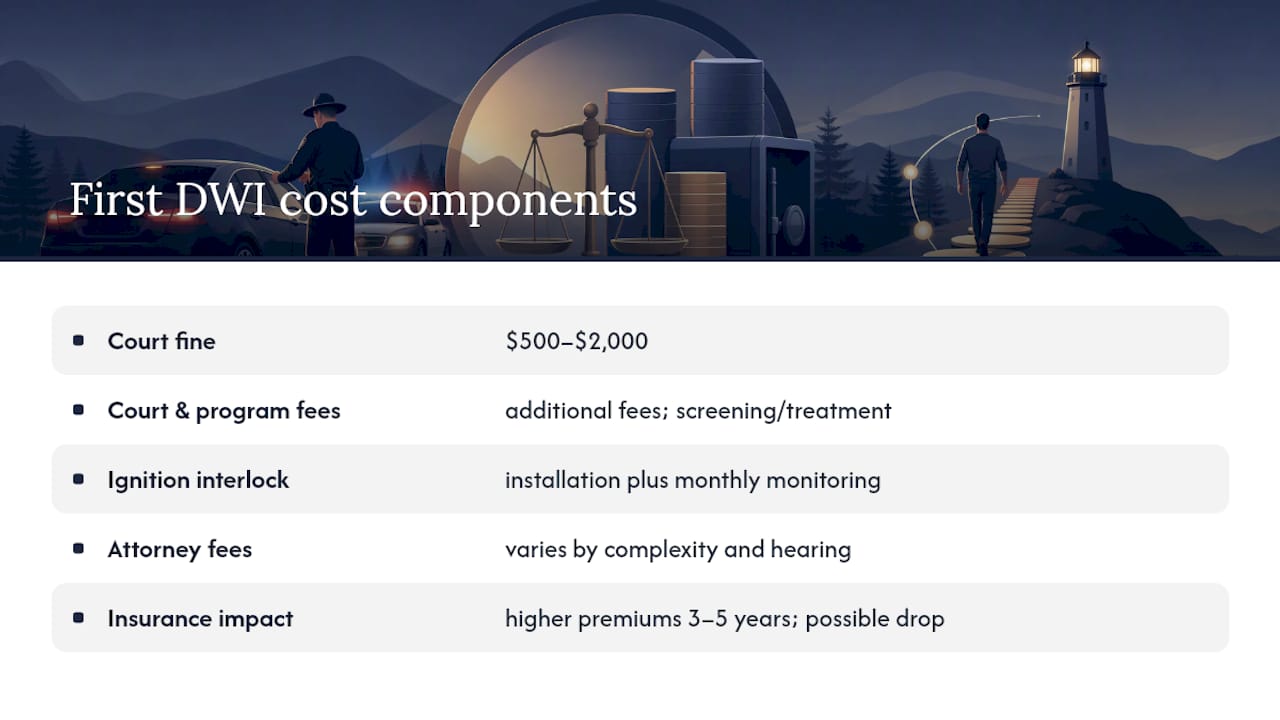
The court-ordered fine is often the smallest piece of the total bill. Court fees, IDCMP screening and treatment fees, and any ignition interlock installation and monthly monitoring costs all stack on top of the base $500 to $2,000 fine range.
Attorney fees add another layer, and they vary widely based on case complexity, whether you contest the ALS suspension, and whether the case goes to a hearing or resolves through negotiation. Skipping representation to save money upfront can backfire if it means missing the ALS hearing deadline or accepting a plea that carries harsher long-term terms than necessary.
The cost that surprises people most is insurance. A DWI conviction routinely triggers a “high-risk” reclassification with your auto insurer, and premium increases commonly last three to five years. Some insurers drop drivers entirely after a conviction, forcing a shift to a nonstandard carrier at a steeper rate. Add in lost wages from court appearances, potential job consequences if your role requires driving or a clean record, and the true cost of a first DWI often runs several times higher than the fine printed on the sentencing order.
What Are the Steps From Arrest to Case Resolution in New Hampshire?
A first-offense DWI case moves through a fairly predictable sequence, even though the timeline varies by county court schedule.
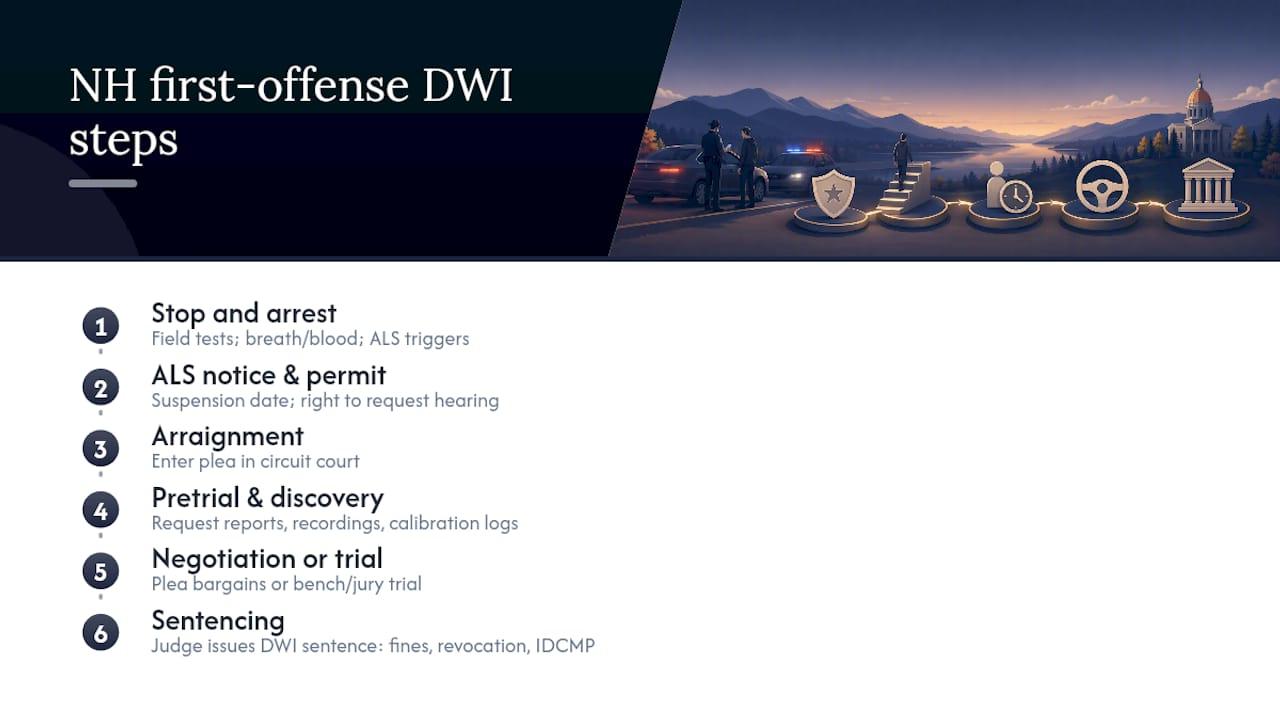
Step 1: The stop and arrest. An officer develops probable cause, administers field sobriety tests, and may request a breath or blood test. Refusal or a BAC of 0.08 or higher (0.02 under 21) triggers the ALS process on the spot.
Step 2: Notice and temporary permit. You receive the ALS notice, which explains your suspension effective date and your right to request a hearing within the stated window.
Step 3: Arraignment. You appear in circuit court to hear the charge and enter an initial plea, typically not guilty, while your defense investigates.
Step 4: Pretrial and discovery. Your attorney requests police reports, dispatch recordings, and testing device calibration logs, and may file motions challenging evidence.
Step 5: Negotiation or trial. Many first-offense cases resolve through negotiated pleas; others proceed to a bench or jury trial if the evidence supports contesting the charge.
Step 6: Sentencing. If convicted or upon a plea, the judge completes the DWI Sentencing Order form, setting fines, revocation length, IDCMP conditions, and any interlock requirement.
Can a First DWI Be Reduced or Dismissed Through a Plea?
Plea negotiations are common in first-offense DWI cases, and outcomes depend heavily on the strength of the evidence and your compliance history. Prosecutors sometimes agree to reduce a DWI to a reckless driving charge when the BAC is close to the legal threshold and there are no aggravating facts, which can mean a different set of consequences than a DWI conviction carries. Our comparison of DUI versus reckless driving in New Hampshire breaks down how the two charges diverge in practice.
Other negotiated outcomes include a reduced revocation period in exchange for early IDCMP compliance, or a court’s agreement to consider a motion reducing the conviction to a violation-level offense once treatment conditions are met. Full dismissal is less common but not impossible, particularly when there’s a genuine problem with probable cause, testing procedure, or chain-of-custody. What a plea actually gets you depends entirely on the specific facts, so generic promises about “getting it dropped” from any source should be treated with skepticism until someone has reviewed your police report and test records.
What a Reasonable Outcome Often Looks Like in NH Courts
Compliant first offenders with no aggravating facts tend toward the lower end of fines and shorter suspended revocation. BAC level, driving conduct, and how fast you complete IDCMP screening consistently move the needle more than anything else.
— Rich
Get Help With Your First DWI Case Today
Fighting an ALS suspension or a first-offense DWI charge in New Hampshire on your own means going up against testing equipment records, deadline-sensitive hearings, and a sentencing form that locks in your conditions for months. Certain legal services provide courtroom-tested review of the breath test evidence, ALS hearing representation filed within the deadline, help navigating IDCMP screening and interlock requirements, and support pursuing DMV license reinstatement once conditions are met.
If you were arrested for a first-offense DWI anywhere in New Hampshire, the clock on your ALS hearing is already running. Reach out to discuss your DUI defense options now, before evidence disappears and deadlines pass.
This article is general information, not a substitute for advice from a qualified lawyer. Consult a qualified legal professional about your own circumstances before acting on anything here.
Sources
- 265-A:18 Penalties for intoxication or under influence of drugs offenses — New Hampshire General Court
- DWI Sentencing Order – 1st Offense | New Hampshire Judicial Branch
FAQ
How harsh are judges on a first-time DUI in New Hampshire?
Most judges give compliant first offenders room to reduce part of their revocation through IDCMP compliance, but a judge’s leniency drops sharply if there’s an accident, a high BAC, or a refusal to cooperate during arrest.
What is the most common sentence for a first DWI?
A typical sentence includes a fine in the $500 to $2,000 range, a license revocation of six months to a year, and mandatory IDCMP screening, with the exact terms recorded on the DWI Sentencing Order form.
What makes a DUI aggravated in New Hampshire?
A DWI becomes aggravated when factors like a BAC of 0.16 or higher, speeding 30 mph over the limit, causing a collision, or having a passenger under 16 are present, and it carries substantially harsher penalties than a standard first offense.
Can you get your first DWI dropped?
Full dismissal is possible but uncommon, usually tied to a genuine problem with probable cause, testing procedure, or evidence handling. Reduced charges or reduced revocation through negotiation and IDCMP compliance are more typical outcomes, and experienced defense firms evaluate each case’s specific facts to determine which path applies.
