

Yes, boating while intoxicated is illegal in every corner of New Hampshire, on every lake, river, and stretch of coastline the state controls. RSA 265-A bars operating any vessel with a blood alcohol concentration of 0.08% or higher (0.02% under 21), and a conviction costs you a significant loss of boating privileges, a driver’s license suspension for a period determined by law, fines, and a record on your driving history.
TL;DR:
- Boating while intoxicated in New Hampshire applies to any vessel used for transportation on water, including motorboats, sailboats, kayaks, and paddleboards with propulsion.
- A blood alcohol concentration of 0.08% or higher (0.02% for operators under 21) is illegal, with officers able to use behavioral signs alone as evidence without requiring a breath test.
- Convictions result in at least one year of revoked boating privileges and an automatic driver’s license suspension ranging from 9 months to 2 years, along with fines and potential jail time for aggravated cases.
- Enforcement involves boarding or stopping vessels, observing impairment signs, and conducting breath, blood, or urine tests, with refusal leading to administrative penalties and adverse court influence.
- Defense strategies focus on challenging the legality of the stop, question test accuracy, and ensuring timely DMV hearing requests, as paperwork discrepancies can be crucial to case outcomes.
Table of Contents
- New Hampshire Boating While Intoxicated Laws: What Counts as BWI
- The Statutes Behind BWI Charges: RSA 265-A:2 and RSA 265-A:19
- Penalties and Collateral Consequences of a BWI Conviction
- How Marine Patrol Enforces BWI and What Testing Involves
- What Happens After a BWI Arrest: The Legal Timeline
- Defenses That Actually Work in BWI Cases
- How Granite Criminal Defense Investigates BWI Charges
- Why the Standard BWI Advice Misses the Point
- Facing a BWI Charge? Talk to Granite Criminal Defense First
- Sources
- FAQ
New Hampshire Boating While Intoxicated Laws: What Counts as BWI
BWI law in New Hampshire doesn’t care what kind of hull you’re sitting in. The statute covers any vessel used for transportation on the water, and the New Hampshire Boater’s Handbook makes clear that includes:
- Motorboats and personal watercraft (jet skis, WaveRunners)
- Sailboats operating under power or sail
- Canoes and kayaks
- Paddleboards, when used with any form of propulsion beyond just floating
The law targets anyone who operates or attempts to operate a vessel while impaired. That second phrase matters. Starting an engine, casting off a line, or moving toward the helm while drunk can trigger a charge even if you never left the dock. Officers also don’t need a breath test to build a case. Slurred speech, poor balance boarding a boat, an open cooler of empty cans, and erratic steering all count as evidence of impairment on their own.
The Statutes Behind BWI Charges: RSA 265-A:2 and RSA 265-A:19
Two statutes do the heavy lifting in every New Hampshire boating intoxication case. RSA 265-A:2 sets the prohibition itself: no one may operate or attempt to operate a vessel while under the influence of alcohol or drugs, or with a BAC of 0.08% or more (0.02% for operators under 21).
RSA 265-A:19 spells out what happens next.
A conviction triggers a one-year loss of the privilege to operate any vessel on New Hampshire waters, and the conviction gets reported directly to the Division of Motor Vehicles, following a person’s driving record even though the offense happened on water, not the road.
The statute also carries aggravated provisions. If the offense causes serious bodily injury or death, charges escalate well beyond the standard misdemeanor track, and penalties climb accordingly. Anyone facing that level of exposure should read the full statutory language rather than rely on a summary.
Penalties and Collateral Consequences of a BWI Conviction
A first BWI conviction hits on two fronts at once: your boating privileges and your driver’s license. Losing both isn’t an exaggeration.
- Boating privileges: revoked for a minimum of one year under RSA 265-A:19
- Driver’s license: suspended for 9 months to 2 years, even though the underlying offense involved a boat, not a car
- Fines: standard monetary penalties apply, with steeper amounts for repeat offenses
- Jail exposure: possible for aggravated cases, repeat convictions, or incidents involving injury
- Driving record: the conviction is reported to the Division of Motor Vehicles and stays there
A detail most boaters miss: the DMV consequences are often the part that blindsides people, because they expect a boating charge to stay on the water. Instead, it can raise your auto insurance rates and trigger the same administrative sanctions as a car DUI.
Penalties escalate further if you were transporting a person under 16 at the time of the offense. New Hampshire law layers on requirements for a substance use evaluation, impaired-driver education, and in some cases residential treatment programs on top of the standard sentence, per the statutory penalty structure. Causing injury or death raises the stakes into felony-level territory, with far longer license suspensions and the possibility of state prison time.
How Marine Patrol Enforces BWI and What Testing Involves
The New Hampshire Marine Patrol handles most BWI enforcement on state waters, working alongside local police departments in towns with lake or coastal access. When an officer suspects impairment, expect this general sequence:
- An officer boards or stops the vessel and observes behavior, speech, and balance
- Field sobriety tasks get adapted for a rocking deck, which is harder than it sounds
- Breath testing is standard; blood or urine tests come into play in cases involving injury, death, or refusal
New Hampshire operates under implied consent. Take a vessel out on state waters and you’ve already agreed to submit to testing if an officer has reasonable grounds to suspect impairment. Refuse, and you face separate administrative penalties, plus prosecutors can point to that refusal in court as consciousness of guilt.
Pro Tip: Alcohol hits harder on the water. Sun, engine vibration, wave motion, and dehydration all amplify impairment, so a BAC that would barely register as a concern on land can put you well over the legal threshold offshore.
What Happens After a BWI Arrest: The Legal Timeline
A BWI arrest sets off two separate clocks running at once: a criminal case and a DMV administrative action.
- Booking and initial processing happen immediately, often at a local station near the marina or boat launch where the stop occurred.
- Arraignment follows within days, where the charge is formally read and bail conditions are set.
- DMV administrative suspension starts running in parallel, tied to the DMV’s suspension and restoration process. You typically have a narrow window to request a hearing and contest the suspension before it takes effect automatically.
- Pretrial motions and discovery unfold over the following weeks, where defense counsel can challenge evidence, request test records, and negotiate.
- Plea or trial resolves the case, with restoration of boating and driving privileges timed to sentencing terms and any required education programs.
Missing the DMV hearing deadline is one of the costliest mistakes people make. It can mean an automatic suspension with no chance to contest it later.
Defenses That Actually Work in BWI Cases
Not every BWI arrest holds up under scrutiny. Prosecutors need clean evidence, and gaps show up more often than most people expect.
- Challenging whether the officer had legal grounds to stop or board the vessel in the first place
- Scrutinizing breath machine calibration and maintenance logs for lapses
- Questioning chain of custody on blood or urine samples
- Raising medical conditions or legal prescription medications that mimic impairment symptoms
If you’re arrested, write down everything you remember while it’s fresh: what the officer said, how the tests were administered, and the exact timeline. Get a lawyer involved immediately, and don’t answer questions beyond identifying yourself. Anything you say gets used against you, and there’s no upside to volunteering explanations before you’ve talked to counsel.
Pro Tip: If bail becomes an immediate concern after arrest, resources like Carter Bail Bonds explain how the bond process typically works so you’re not navigating it blind.
Independent testing or expert review of the breath or blood evidence makes sense whenever the case hinges on a close BAC reading or contested test administration.
How Granite Criminal Defense Investigates BWI Charges
Granite Criminal Defense brings over 30 years of courtroom experience to BWI cases, and that experience shows up in the details prosecutors don’t expect anyone to check. The firm’s approach typically includes:
- Pulling breath-machine maintenance and calibration records directly from the vendor
- Reviewing lab reports for blood or urine samples line by line
- Interviewing witnesses who were on scene, including other boaters
- Coordinating criminal defense strategy with the parallel DMV administrative hearing to protect driving privileges, not just the boating charge
That dual-track approach matters because a criminal defense win doesn’t automatically undo a DMV suspension. They have to be handled together, from day one.
Why the Standard BWI Advice Misses the Point
Most explainers on boating intoxication laws stop at the BAC number and the fine amount. That’s the least useful part of the picture. The real exposure sits in the driver’s license suspension, the insurance fallout, and the fact that a boating charge follows you onto the highway record for months or years.

Conventional advice also underplays how much of a BWI case turns on paperwork rather than the water itself. Breath machine logs, calibration dates, and chain-of-custody forms decide more cases than dramatic cross-examinations do. If you were arrested, the first move isn’t hiring the loudest lawyer in the phone book. It’s finding one who will actually pull the maintenance records before your first hearing date.
The other habit worth breaking: treating the DMV hearing as an afterthought. By the time most people focus on it, the window to request a hearing has already closed. Prioritize that deadline the same day as your arraignment, not after.
— Rich
Facing a BWI Charge? Talk to Granite Criminal Defense First
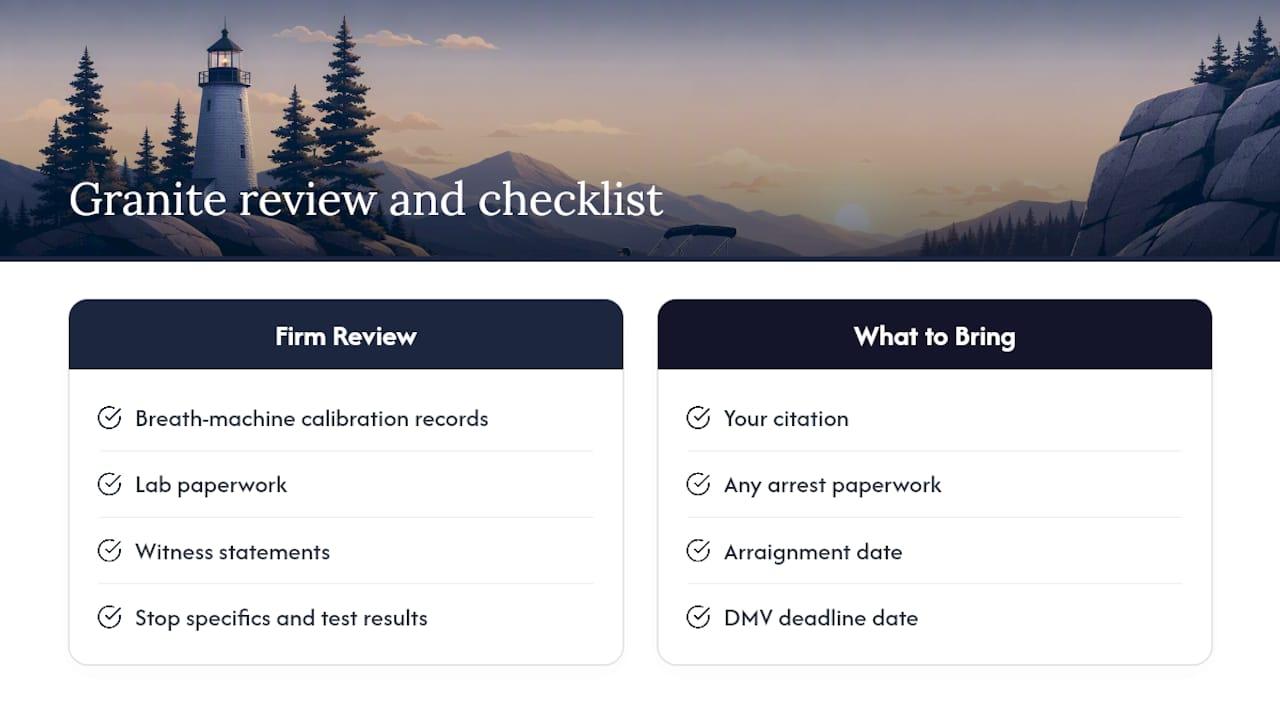
Granite Criminal Defense reviews BWI evidence the way prosecutors build it: pulling breath-machine calibration records, lab paperwork, and witness statements before deciding how strong the state’s case really is. That’s the edge a standard consultation rarely offers. A free case review covers the specifics of your stop, your test results, and the DMV clock that’s already running, and the firm handles both the criminal charge and the administrative hearing side by side, including bilingual English/Spanish representation when needed. Bring your citation, any paperwork from the arrest, and dates for the arraignment and DMV deadline. Granite Criminal Defense represents clients throughout New Hampshire, and the next step is simple: start your case review today before your hearing window closes.
This article is general information, not a substitute for advice from a qualified lawyer. Consult a qualified legal professional about your own circumstances before acting on anything here.
Sources
- New Hampshire Boater’s Handbook (Kalkomey)
- NH Rev Stat § 265-A:19 (Penalties for Boating While Intoxicated) — Justia
FAQ
Can you drink while driving a boat in New Hampshire?
No. Operating or attempting to operate any vessel with a BAC of 0.08% or higher (0.02% under 21) violates RSA 265-A:2, regardless of how much you drank before or during the trip.
Can I drink beer while on a boat in New Hampshire?
Having a drink as a passenger isn’t itself illegal, but the operator faces criminal exposure the moment their BAC crosses the legal threshold, and impairment from just one or two drinks can hit harder on the water than on land.
What is the 1/3 rule in boating?
There’s no formal “1/3 rule” written into New Hampshire statute, but boating safety guidance notes that factors like sun, motion, and dehydration can make alcohol’s effects on the water considerably stronger than the same amount would produce on land.
Is a BWI a felony in New Hampshire?
A standard first BWI is typically charged as a misdemeanor, but it can escalate to felony-level charges when the offense involves serious injury or death, carrying far longer license suspensions and potential prison time.
